
August 17, 2026
August 18, 2026 · 8 min read
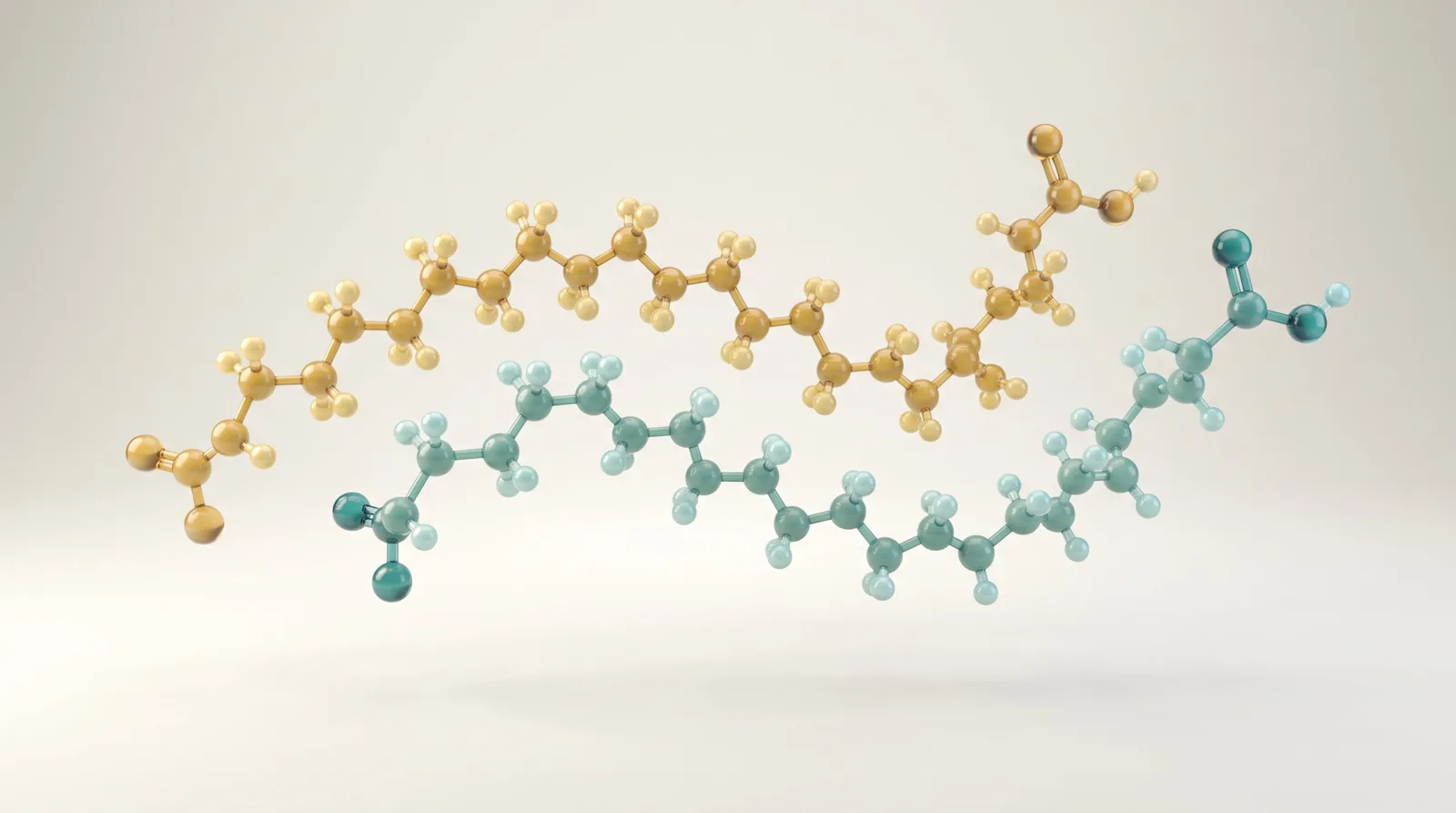
Give 154 adults 2.7 g a day of pure DHA for ten weeks and their triglycerides fall 13.3%. Give the same people the same dose of pure EPA and they fall 11.9%.
That gap is small. Others are not.
Only nine randomised trials have ever done what that study did — hand people near-pure EPA or near-pure DHA at 2 g a day or more, then compare. Philip Calder's group at Southampton pulled all 24 publications from those nine trials together in 2024.
Their summary is blunt. DHA lowers blood pressure and heart rate more than EPA. DHA lowers triglycerides slightly more. DHA raises LDL cholesterol more. On inflammation and oxidative stress, the two are broadly similar.
So the answer to "which one" is not one molecule. It is a set of trade-offs, and they are worth knowing before you pick a bottle.
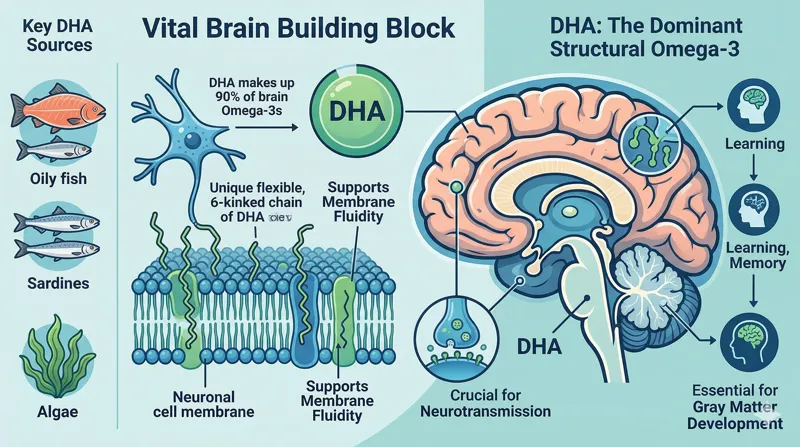
The clearest difference is where each one ends up. DHA makes up over half the phospholipid fatty acids in the outer segments of your photoreceptors. It is a building material there, not a signal.
The brain treats EPA very differently. In rat brain, EPA sits 250 to 300 times lower than DHA. It is not that EPA cannot get in. It is that it gets burned once it does.
Rat work at Toronto measured the loss rate directly. Esterified EPA left brain phospholipids at 14% a day. DHA, arachidonic acid and palmitate all left at 2% a day.
That is rodent data, and brains are not the only tissue that matters. But it explains a pattern you see repeatedly: EPA acts through what it turns into, DHA acts through what it becomes part of.
Mori and colleagues in Perth ran the cleanest test of this in 1999. Fifty-nine overweight, mildly hyperlipidaemic men took 4 g a day of purified EPA, purified DHA or olive oil for six weeks.
Against placebo, DHA lowered 24-hour ambulatory blood pressure by 5.8/3.3 mmHg. Daytime readings fell 3.5/2.0 mmHg. Ambulatory heart rate fell across the 24 hours, daytime and night.
EPA did neither. Same dose, same men, same six weeks, no movement.
The 2024 review found the same direction across the trial set: DHA is more effective than EPA at decreasing heart rate and blood pressure. A 5.8 mmHg fall in 24-hour systolic is not trivial — but it took 4 g of a single fatty acid, which no ordinary capsule delivers.
The ComparED study is the best head-to-head lipid data we have. It gave 154 adults with abdominal obesity 2.7 g a day of EPA, DHA or corn oil for ten weeks each, in crossover.
Triglycerides fell 13.3% on DHA and 11.9% on EPA, p=0.005. A small win for DHA.
LDL went the other way. In men, LDL cholesterol rose 12.5% on DHA against 5.1% on EPA. In women the rise was 4.4% and 3.0%, and the difference did not reach significance.
That is a genuine cost, and most omega-3 copy skips it. The counterweight is that DHA also increased LDL particle size, and larger particles are generally regarded as less atherogenic. Whether the net effect on risk is positive, negative or nil was not measured. Anyone telling you it is settled is guessing.
This is where the marketing and the data part company. Both fatty acids are sold on inflammation, and in a direct comparison they mostly behave the same.
ComparED measured five markers. CRP, IL-6 and tumour necrosis factor alpha showed no significant difference between DHA and EPA.
Two did move apart. IL-18 fell 7.0% on DHA against 0.5% on EPA, p=0.01. Adiponectin rose 3.1% on DHA and fell 1.2% on EPA, p<0.001.
IL-18 and adiponectin are not the markers anyone advertises on. If you are choosing between EPA and DHA to lower CRP, the head-to-head evidence gives you no basis for the choice.
A 2019 meta-analysis in Translational Psychiatry pooled 26 randomised trials of omega-3 in people with depressive symptoms, and split them by which fatty acid dominated.
The EPA-only groups showed a standardised mean difference of −0.48, p<0.001. EPA-majority formulations, meaning at least 60% EPA, came in at −0.33.
The DHA arms found nothing. DHA-only gave −0.39 at p=0.34. DHA-majority gave +0.11 at p=0.95. Both confidence intervals crossed zero comfortably.
Dose mattered too: the benefit sat at 1 g a day of EPA or below, and disappeared at higher doses. Note the population — these were people already carrying a clinical diagnosis, not healthy 50-year-olds looking for a lift. The finding does not transfer to you automatically.
Two large trials asked whether any of this changes what happens to people. They disagreed, and the disagreement is unresolved.
REDUCE-IT gave 8,179 statin-treated patients 4 g a day of icosapent ethyl, which is EPA alone. A primary endpoint event occurred in 17.2% on EPA against 22.0% on placebo, hazard ratio 0.75, 95% CI 0.68 to 0.83.
STRENGTH gave 13,078 similar patients a high-dose EPA plus DHA carboxylic acid. It was stopped early for futility. No significant difference against corn oil.
Three explanations compete. The formulations differed. The placebos differed — REDUCE-IT used mineral oil, which may have nudged the comparison group in the wrong direction. Or DHA genuinely blunts something EPA does.
Nobody has settled it. What you can say honestly is that the only large outcome trial with a positive result used EPA on its own, at 4 g a day, in patients on statins with raised triglycerides. That is a narrow population and a pharmaceutical dose.
Red blood cell omega-3 responds to dose in a fairly predictable way. Pooling 1,422 people across 14 trials, a mean intake of 1,983 mg a day moved the omega-3 index from 4.9% to 8.1%.
Two practical details from that model. Dose, starting level and chemical form explained 62% of the variation. And triglyceride-form supplements raised the index about one percentage point more than ethyl esters, gram for gram.
The GB claims register sets a much lower bar than any of the trials above.
Two portions of oily fish a week, as the NHS suggests, gets most people past the 250 mg rungs. It does not get anyone near 2 or 3 g a day.
Across ten weeks in 154 adults with abdominal obesity, DHA lowered triglycerides more than EPA (−13.3% against −11.9%, p=0.005) and lowered IL-18 more (−7.0% against −0.5%, p=0.01). LDL cholesterol rose more on DHA in men (12.5% against 5.1%). CRP, IL-6 and TNF-alpha showed no difference between the two.
Source: Allaire et al., American Journal of Clinical Nutrition, 2016 (n=154).
Our own oil is DHA-led rather than a blend, and that is worth being straight about. It sits well with the blood pressure and triglyceride evidence. It sits badly with the mood evidence, which points at EPA.
You do get some EPA either way. Conquer and Holub reported plasma EPA rising 11 to 12% in vegetarians after six weeks on 1,620 mg of algal DHA. The mechanism is contested — isotope work in rat liver suggests conversion backwards is a minor contributor, and that slower EPA turnover explains more of it.
So a DHA-only product is not an EPA-free existence. It is also not a way to reach the EPA doses used in the mood trials.
Three practical rules. If your target is blood pressure or triglycerides, the evidence favours DHA and the useful doses start around 2 g. If your target is mood, it favours EPA at 1 g a day or less, and that is a conversation for your GP rather than a supplement aisle. If you have no specific target, oily fish twice a week gives you both, cheaply.
Read a label for the split, not the total. "1,000 mg omega-3" tells you nothing useful. 500 mg DHA and 100 mg EPA is a different product from the reverse, and the trials say different things about each.
Then match it to a target. DHA has the better case on blood pressure, heart rate, triglycerides and structural roles in the retina and brain — that last part covered in more detail in our piece on DHA and brain health, and tested honestly against memory outcomes in what the memory trials found. EPA has the better case on mood and the only positive large outcome trial.
Both have a worse case than the category implies. The differences described here come from nine trials, most of them small, most of them at doses no capsule provides. That is a thin base for the confidence with which these products are sold.
If you want to see how the sourcing question interacts with this, our algae versus fish oil comparison and the vegan omega-3 buyer's guide cover it. And if you want to know what is actually in ours, the Omega-3 DHA page lists the per-capsule split.
August 17, 2026
April 4, 2026