Dosage Guide
The Complete NMN Dosage Guide: How Much to Take, When, and How
April 4, 2026 · 9 min read
One of the most common questions people ask when starting NMN supplementation is simple: how much NMN should I take per day? The answer depends on your age, body weight, health goals, and whether you are combining NMN with other supplements like resveratrol. This guide covers everything you need to know about NMN dosage — from the research-backed amounts, to the best time of day to take it, to how long it takes to see results.
How Much NMN Should You Take Per Day?
Based on current clinical research, here are the general dosage guidelines for NMN supplementation. For most adults aged 30 to 60, 500mg per day is the most widely studied and recommended dose. A 2022 multicenter clinical trial found that clinical efficacy — measured by blood NAD+ concentration and physical performance — was highest at 600mg of daily oral NMN intake. Doses as low as 250mg per day have shown measurable benefits in some studies, while human trials have demonstrated safety at doses up to 1,200mg daily.
NMN Dosage by Age and Body Weight
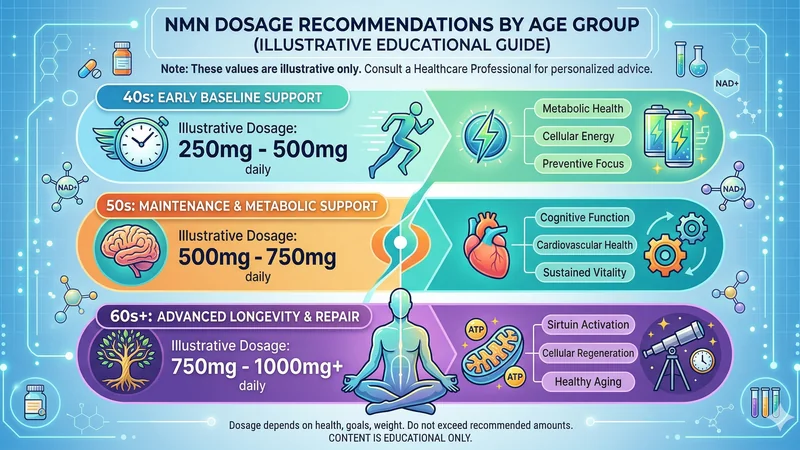
NAD+ levels decline naturally with age — dropping roughly 40 to 50 percent between your twenties and age 50, with an estimated 10 to 15 percent decline per decade after 40. This means older adults generally benefit from higher doses to compensate for a steeper NAD+ deficit.
| Age Range | Body Weight | Suggested Daily Dose | Notes |
|---|---|---|---|
| 25–35 | Under 70kg | 250mg | NAD+ decline is just beginning; lower dose may suffice |
| 25–35 | Over 70kg | 250–500mg | Higher body mass may benefit from a moderate increase |
| 36–45 | Under 70kg | 250–500mg | NAD+ decline is accelerating; 500mg is a solid baseline |
| 36–45 | Over 70kg | 500mg | The most commonly studied dose for this demographic |
| 46–55 | Any weight | 500–750mg | NAD+ has dropped significantly; higher dose recommended |
| 56–65 | Any weight | 500–1,000mg | Steeper NAD+ deficit; some benefit from the upper range |
| 65+ | Any weight | 500–1,000mg | Consult your healthcare provider for personalised advice |
These are guidelines, not prescriptions. Individual responses vary, and it is always wise to start at the lower end and increase gradually. Our NMN + Resveratrol delivers 500mg of NMN per two-capsule serving, which sits right in the research-supported sweet spot for most adults.
NMN 250mg vs 500mg vs 1,000mg: Which Is Right for You?
At 250mg per day: This is a good entry point for younger adults or those new to NMN supplementation. Clinical studies have found health benefits at this level, including improvements in walking speed and grip strength in older adults. It is the most conservative effective dose.
At 500mg per day: This is the most commonly studied dose and represents the best balance of efficacy and value for most people. The majority of positive clinical outcomes — improved energy, better NAD+ biomarkers, enhanced physical performance — have been observed at or near this level.
At 1,000mg per day: This higher dose may benefit adults over 55 or those with significantly depleted NAD+ levels. Some users split this into two 500mg doses (morning and midday). While safe based on current research, starting at 500mg and working up is a prudent approach.
Best Time to Take NMN: Morning or Night?
For most people, morning is the best time to take NMN. NAD+ production follows your body's circadian rhythm, with levels naturally peaking in the morning and dipping at night. Taking NMN in the morning aligns with this cycle, supporting your body's energy production when it needs it most. Survey data suggests roughly 68 percent of NMN users prefer morning dosing, with the majority reporting better energy levels throughout the day.
Taking NMN too close to bedtime may interfere with sleep for some people, as it supports cellular energy production. That said, a smaller subset of users (around 22 percent) prefer evening dosing and report that it supports better sleep quality and overnight recovery. The most important thing is consistency — taking NMN at the same time each day matters more than choosing the theoretically perfect hour.
Should You Take NMN on an Empty Stomach or With Food?
NMN is water-soluble, which means it can be absorbed effectively whether you take it with food or without. Taking NMN on an empty stomach may lead to slightly faster absorption, as there are fewer other nutrients competing for uptake in the gut. Many users find that taking it first thing in the morning before breakfast works well for this reason.
However, if you experience any mild digestive discomfort on an empty stomach, taking NMN with a small meal or snack is perfectly fine and will not meaningfully reduce its effectiveness. There is one important caveat if you are taking NMN together with resveratrol.
Can You Take NMN and Resveratrol at the Same Time?
Yes, and in fact there is strong scientific rationale for combining them. NMN and resveratrol work through complementary mechanisms: NMN boosts your NAD+ levels (providing the raw material), while resveratrol activates the sirtuin proteins that use NAD+ to carry out cellular repair, DNA maintenance, and metabolic regulation. Research suggests the combination can be more effective than either supplement alone — one study found that NMN combined with resveratrol boosted NAD+ levels 1.6 times higher in heart tissue and 1.7 times in muscle tissue compared to NMN by itself.
When taking NMN and resveratrol together, absorption matters. While NMN is water-soluble, resveratrol is fat-soluble — meaning it is absorbed much better when consumed with dietary fats. Taking your combined supplement with a source of healthy fats (avocado, nuts, olive oil, or eggs) can significantly improve resveratrol bioavailability. Our NMN + Resveratrol formula also includes 10mg of BioPerine (black pepper extract), which research suggests can enhance nutrient absorption by up to 30 percent.
NMN Capsules vs Sublingual vs Powder: Absorption Compared
Capsules are the most common form and the most convenient. They deliver a precise, consistent dose and are easy to incorporate into a daily routine. Modern NMN capsules provide excellent bioavailability, especially when formulated with absorption enhancers like BioPerine.
Sublingual (under the tongue) NMN is often marketed as having superior absorption because it bypasses the digestive system. While this is true in theory, the practical advantage over capsules is debated, and sublingual delivery requires holding powder under your tongue for several minutes — something many find inconvenient.
Powder offers dosing flexibility but requires measuring, which introduces consistency issues. For most people, a well-formulated capsule with an absorption enhancer provides the best balance of efficacy, convenience, and consistency.
How Long Does It Take for NMN to Work?
NMN begins being absorbed and metabolised within 30 to 60 minutes of ingestion. But the benefits unfold on different timescales depending on what you are tracking.
Week 1 to 2: Many users report subtle improvements in morning energy and alertness. This is often described as a cleaner, more sustained energy rather than a stimulant-like boost. Some notice they need less coffee or feel less of an afternoon slump.
Month 1: Energy improvements tend to become more consistent and noticeable. Improved focus and mental clarity are commonly reported at this stage.
Month 2 to 3: Many users begin seeing changes beyond energy. Improvements in skin texture, exercise recovery, and sleep quality are frequently reported. A clinical study found that 500mg of NMN daily for 12 weeks increased hair diameter in middle-aged women.
Month 3 to 6: Deeper cellular and metabolic benefits accumulate. Blood NAD+ levels are typically significantly elevated by this point. For a detailed month-by-month breakdown, see our NMN results timeline guide.
NMN vs NR: Which NAD+ Precursor Is Better?
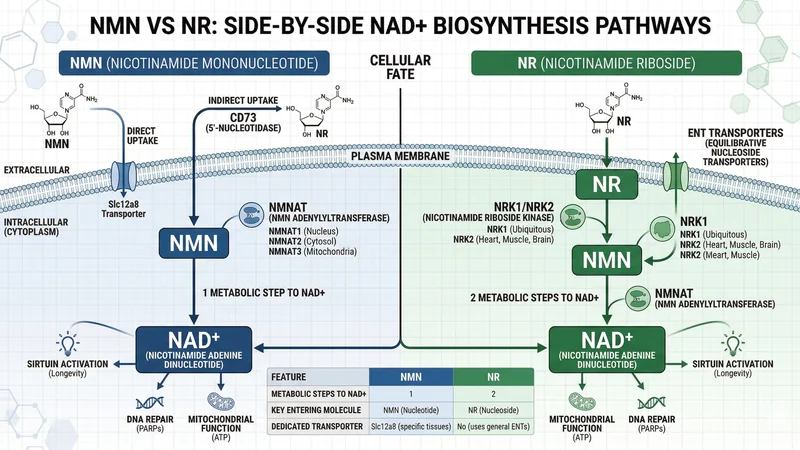
Both NMN (nicotinamide mononucleotide) and NR (nicotinamide riboside) are precursors to NAD+, but NMN is one step closer to NAD+ in the biosynthetic pathway. It converts directly to NAD+ via the enzyme NMNAT, whereas NR must first be converted to NMN before being converted to NAD+. This extra step means NR requires more metabolic processing. Both have clinical evidence, but NMN has the advantage of a more direct conversion pathway and a rapidly growing body of human clinical trial data.
Frequently Asked Questions
Can I take NMN every day?
Yes. NMN is intended for daily use. Clinical studies evaluating daily supplementation for periods of several months have shown it to be safe and well-tolerated at doses up to 1,200mg per day.
What happens if I miss a day?
Missing an occasional day is not a concern. NAD+ levels will temporarily dip but will recover once you resume supplementation. The key is overall consistency rather than perfection.
Can I take NMN with other supplements?
NMN pairs particularly well with resveratrol (sirtuin activation), Omega-3 DHA (brain and heart health), and vitamin D. If you take prescription medications, consult your healthcare provider to rule out interactions.
Should I cycle NMN or take it continuously?
There is currently no scientific evidence suggesting that cycling NMN is necessary or beneficial. Most researchers and experienced users take it continuously as a daily protocol.
This guide is for informational purposes and does not constitute medical advice. Always consult your healthcare provider before starting any new supplement, particularly if you are pregnant, nursing, take medications, or have underlying health conditions.
Continue Reading
March 15, 2026