
March 26, 2026
July 25, 2026 · 14 min read

There is a moment that people who take NMN consistently tend to describe in almost identical words. They are halfway up a flight of stairs they climb every day, and they realise they are already at the top. Or they are on a run they have done a hundred times, approaching the point where they always start to fade — and it doesn't come. The mile marker where the legs usually go heavy passes by, and they are still moving well.
What is striking is what they don't describe. No rush. No lift. No sharpening behind the eyes. Nothing that announces itself the way a double espresso does. There was no moment where they felt the supplement "kick in", because there was nothing to kick in — and yet the capacity is measurably different.
We have started calling this Quiet Energy, because the vocabulary we have inherited for energy is almost entirely wrong.
The central idea of this article: stimulants don't give you energy. They borrow alertness against tomorrow. Energy — the actual, physical, thermodynamic kind — is ATP, and ATP is made by mitochondria using a coenzyme called NAD+. Restore the NAD+ and you don't get a buzz. You get a better engine.
Ask most people what an energy drink does and they will tell you it gives them energy. It doesn't. A sugar-free energy drink contains, in caloric terms, essentially nothing. It cannot possibly be giving you energy in any physical sense, because there is no fuel in the can. What it is doing is something else entirely.
Forty years of advertising have trained us to equate the sensation of stimulation with the capacity to do work. They are not the same thing. They are barely related. And once you understand the difference, the entire supplement aisle reorganises itself in front of you.
Caffeine is an adenosine receptor antagonist. Throughout your waking day, adenosine — a by-product of ATP being spent — accumulates in the brain and binds to A1 and A2A receptors. That binding is the signal you experience as tiredness. It is a fuel gauge. Caffeine is shaped closely enough to adenosine to sit in those receptors without activating them, so the gauge stops reporting.
Read that again, because it is the whole story: caffeine does not add fuel. It covers the fuel gauge. The adenosine is still accumulating behind the blockade the entire time you feel alert, which is precisely why the crash arrives with interest when the caffeine clears — a phenomenon well described in the sleep and chronobiology literature. You did not gain four hours. You borrowed them.
The comparison is worth making because it is the same error taken to its logical extreme. Cocaine is a monoamine reuptake inhibitor: it blocks the transporters that clear dopamine, noradrenaline and serotonin from the synapse, so those signals pile up and fire far beyond their normal range. The user feels enormous energy.
Not one molecule of ATP has been created. Nothing has been added to the system. What has happened is that the body's alarm and reward signalling has been forced wide open, and the resulting output is drawn entirely from reserves the person already had — and, once those are gone, from reserves they didn't. The catastrophic comedown isn't a side effect bolted on to the drug. It is the bill. This is the borrowing model in its purest and most destructive form, and it makes the underlying point unmistakable: feeling energetic and being energetic are different states, and one of them can be counterfeited.
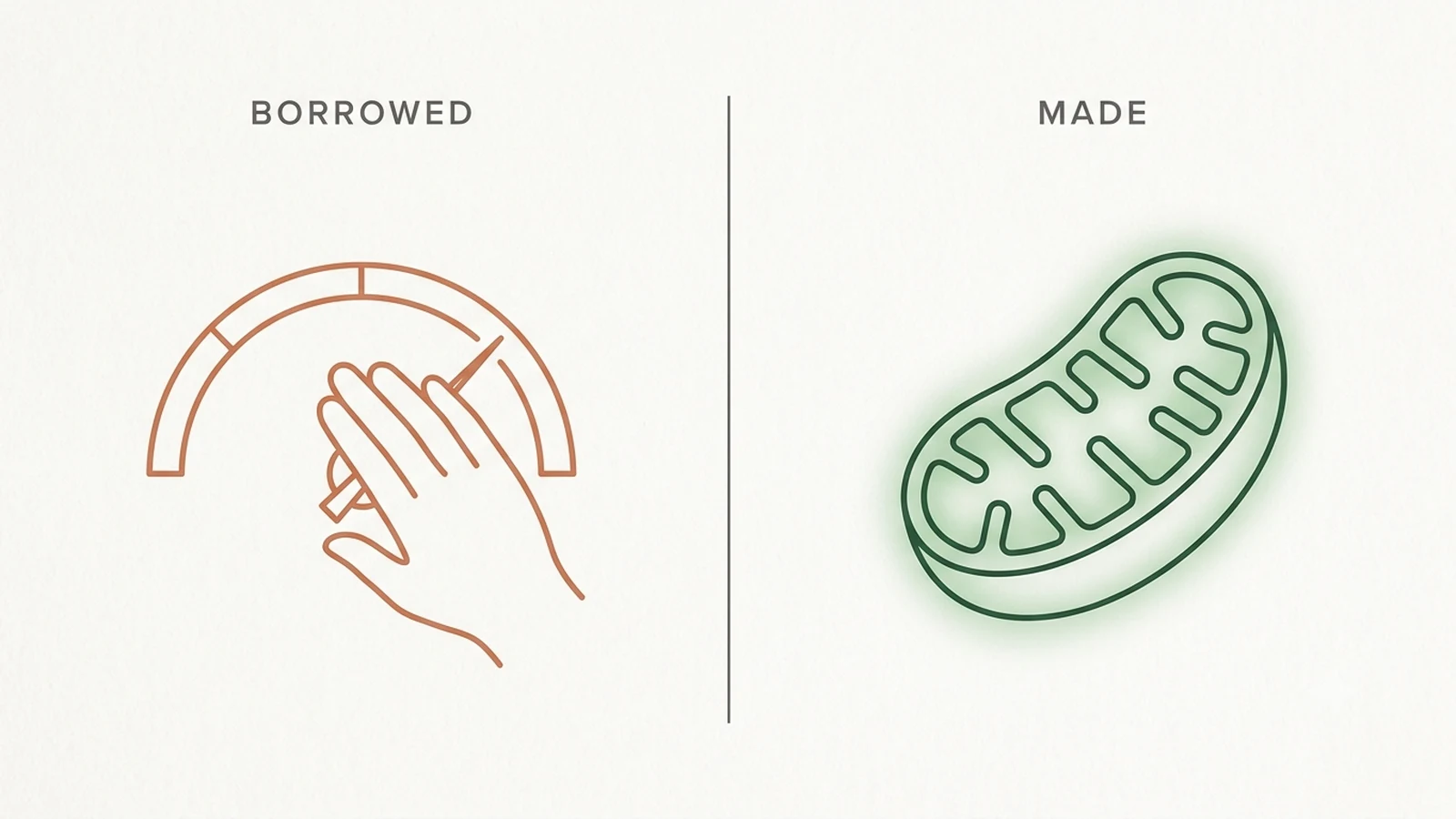
Stimulants operate on perception — how tired you feel. NAD+ operates on production — how much ATP your cells can actually manufacture from the food and fat you have. One is a volume knob on a fatigue signal. The other is the engine.
Every contraction of your quadriceps, every heartbeat, every thought, is paid for in adenosine triphosphate. ATP is the universal currency of biological work. You are not powered by calories in any direct sense — you are powered by ATP, and calories are merely the raw stock from which ATP is manufactured.
That manufacturing happens almost entirely inside your mitochondria, and it runs on a simple principle: strip electrons off fuel molecules, pass them down a chain of protein complexes embedded in the inner mitochondrial membrane, and use the energy released to pump protons across that membrane. The resulting proton gradient drives ATP synthase — a literal molecular turbine — which spins and produces ATP.
And the molecule that carries those electrons from your food to that turbine is NAD+.
Nicotinamide adenine dinucleotide exists in two states. In its oxidised form, NAD+, it is empty and available. It accepts a pair of electrons from a fuel molecule and becomes NADH — loaded. NADH delivers that cargo to Complex I of the electron transport chain, drops it off, and reverts to NAD+, ready to go again. It is a shuttle bus, and it runs continuously, millions of times per second, in every cell you have.
Which means the size of your NAD+ pool sets a hard ceiling on how fast you can burn anything at all. Not enough shuttles, and the fuel simply queues.
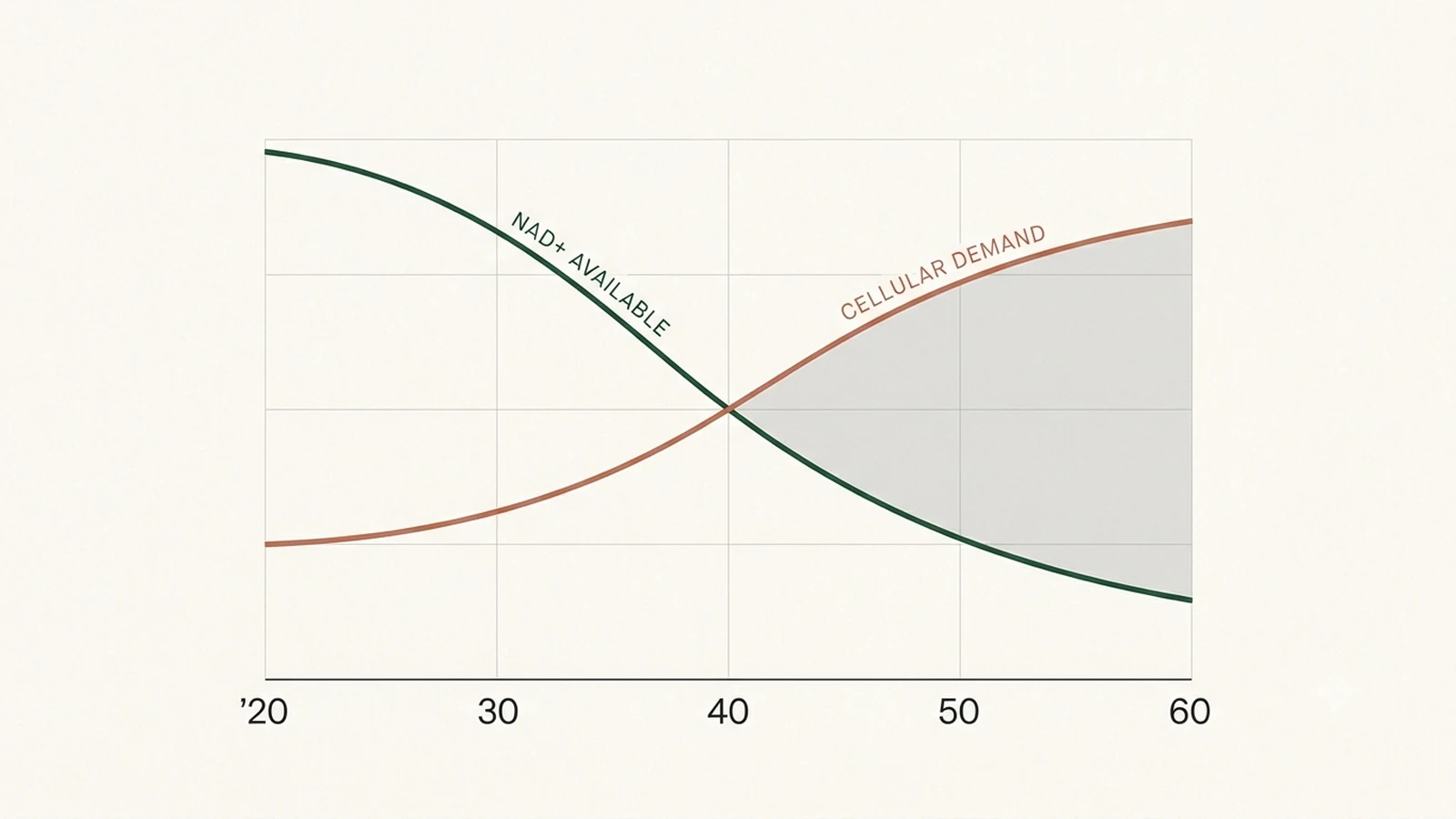
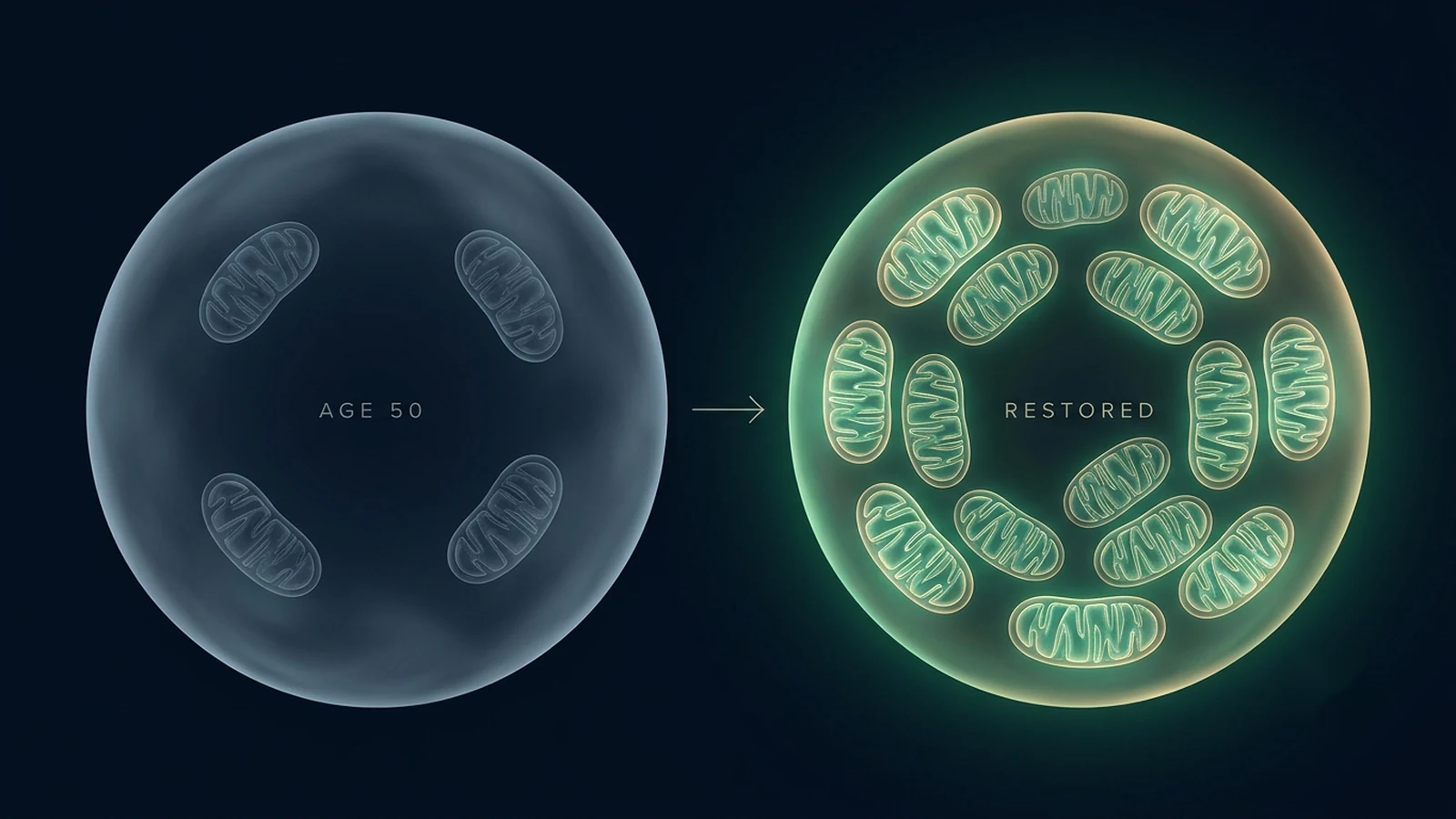
NAD+ is not stable across a lifespan. Tissue NAD+ falls by roughly 50% between the ages of 20 and 50, and continues declining thereafter. The fall is driven from two directions at once: synthesis slows, and consumption rises.
Supply falls. NAMPT — the rate-limiting enzyme in the salvage pathway that recycles nicotinamide back into NMN, and therefore into NAD+ — becomes less expressed with age. Your recycling plant slows down.
Demand rises. NAD+ is not only a metabolic shuttle. It is also the substrate consumed by PARP enzymes during DNA repair and by CD38, an NAD+-degrading enzyme that increases markedly with age and chronic low-grade inflammation. Accumulated DNA damage means PARPs run harder, and every PARP activation and every CD38 turnover permanently destroys an NAD+ molecule. The pool is being drained by the very processes of ageing it is needed to resist.
The lived experience of this maps onto the biochemistry almost too neatly. Through your twenties the surplus is large enough that you never encounter the ceiling. From around 30 the margin narrows — recovery from a heavy session takes an extra day, the last hour of the working day gets harder. Through your forties it is undeniable: the same training produces less, body composition drifts despite unchanged habits, and the afternoon energy trough becomes a fixture. By 50, for most people, it is no longer a trend but a wall — and it is at this point that people typically start reaching for stronger coffee, which is precisely the wrong lever.
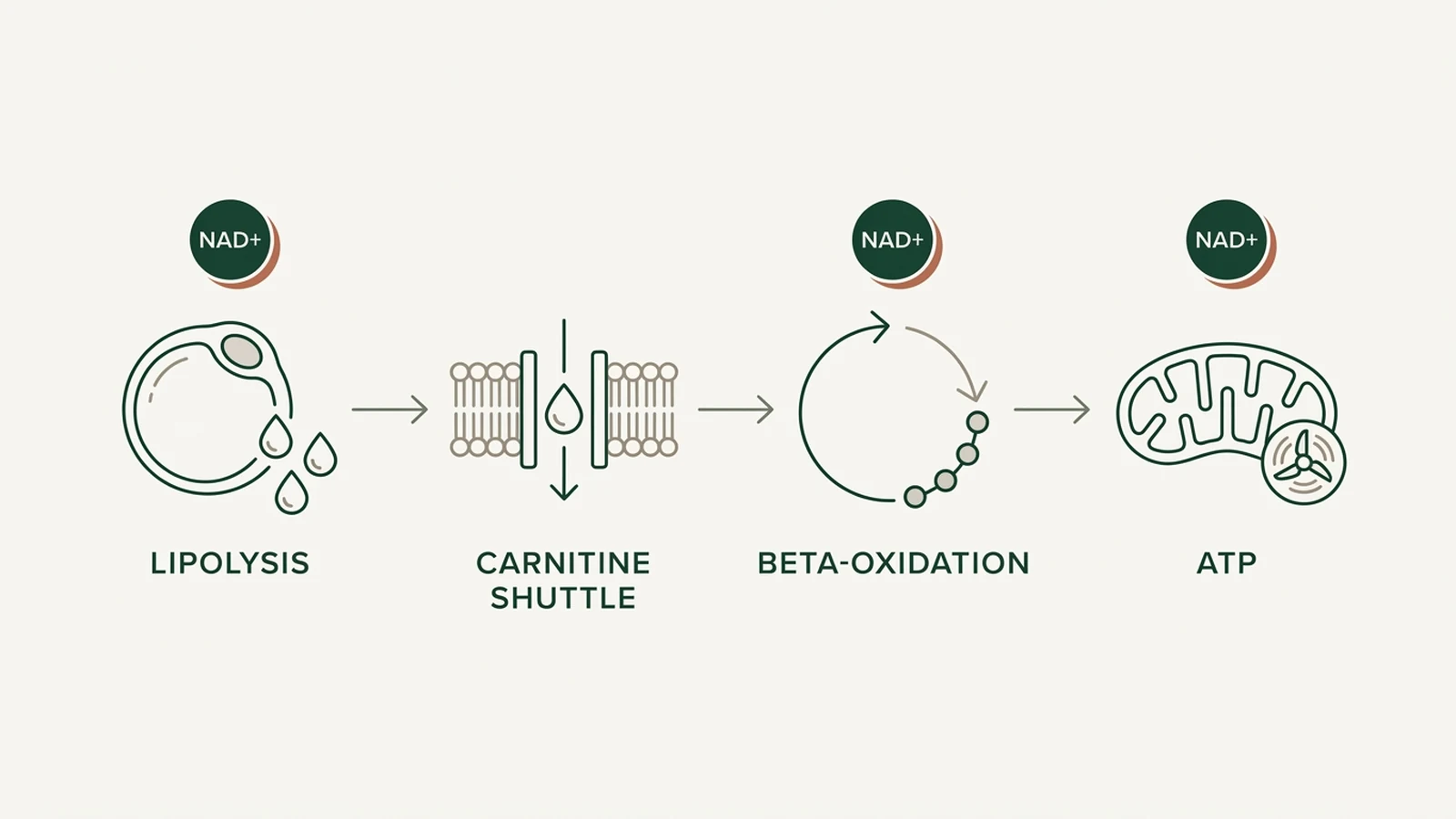
This is where the mechanism becomes genuinely interesting, because burning body fat is not one process. It is a supply chain with four distinct stages, and NAD+ is a dependency at three of them.
Body fat is stored in adipocytes as triglycerides — three fatty acid chains attached to a glycerol backbone. To use it, that molecule must be dismantled. The process is called lipolysis, and it proceeds through three enzymes in sequence: adipose triglyceride lipase (ATGL) makes the first cut, hormone-sensitive lipase (HSL) the second, and monoacylglycerol lipase the third. The output is free fatty acids released into circulation, bound to albumin, and carried toward tissues that need fuel.
ATGL is the rate-limiting step, and its expression is under the control of the SIRT1–AMPK axis — a pathway that cannot function without NAD+. A 2023 study in Biochemistry and Biophysics Reports showed NMN directly inducing lipolysis in adipocytes by upregulating ATGL through exactly this route.
Here is the stage almost nobody talks about, and it is the one that explains why "released fat" and "burned fat" are not the same thing.
Long-chain fatty acids cannot cross the inner mitochondrial membrane on their own. They require an active transport system — the carnitine shuttle. On the outer membrane, carnitine palmitoyltransferase 1 (CPT1) swaps the fatty acid's coenzyme A group for carnitine, forming acylcarnitine. A translocase then ferries that molecule across the inner membrane, where CPT2 reverses the swap and releases the fatty acid into the mitochondrial matrix — inside the furnace at last.
This is the bottleneck that most people never diagnose. You can be in a calorie deficit, training hard, with fatty acids dutifully mobilised into your bloodstream — and if transport and oxidative capacity downstream are limited, a substantial fraction of that fuel is simply re-esterified and put back into storage. The fat left the warehouse, arrived at a furnace running below capacity, and went home again.
Inside the matrix, the fatty acid enters beta-oxidation — a repeating four-step cycle that chops two carbons off the chain per turn, producing one acetyl-CoA each time. Palmitate, a typical 16-carbon fatty acid, goes round seven times.
Step three of every single cycle is an oxidation performed by hydroxyacyl-CoA dehydrogenase, and that reaction has one absolute requirement: a free NAD+ molecule to accept the electrons. No NAD+, no reaction. The cycle stalls where it stands.
Then each acetyl-CoA produced enters the citric acid cycle — which consumes a further three NAD+ molecules per turn. Burning one molecule of palmitate to completion therefore requires somewhere in the region of thirty NAD+ molecules cycling through the loaded and unloaded states.
Picture a loading bay with a fleet of shuttle buses. Fuel arrives at one end; the power station is at the other. The buses are NAD+.
At twenty-five you have a full fleet, and fuel never waits. At fifty you are running half the buses. The fuel still arrives — you have eaten it, you have mobilised it — and it now queues on the forecourt. It hasn't disappeared. It is stuck in a system that lacks the carriers to move it. That queue is what you feel as the third flight of stairs, the mile where your legs go, the wall at 3pm.
The NADH generated across stages three and four hands its electrons to Complex I. Protons are pumped, the gradient builds, ATP synthase spins, and ATP is produced. And in doing so, NADH is converted back to NAD+ — returning the bus to service.
The system is a loop, and the loop's throughput is bounded by two things: the number of NAD+ molecules in the pool, and the number of mitochondria available to cycle them. Which brings us to the two mechanisms that make NMN and resveratrol interesting together rather than separately.
NAD+ has a second job beyond electron transport, and it is arguably the more consequential one. It is the obligatory co-substrate for the sirtuins — a family of seven enzymes (SIRT1 through SIRT7) that regulate metabolism, stress response and mitochondrial function by removing acetyl groups from other proteins.
Sirtuins are unusual in that they consume NAD+ to do their work, which makes them exquisitely sensitive to NAD+ availability. They are, in effect, the cell's fuel sensors: when NAD+ is abundant, sirtuins are active and the cell behaves as though resources are plentiful and worth investing. When NAD+ is scarce, sirtuin activity falls and the cell shifts into conservation.
SIRT1 sits in the nucleus and cytoplasm. Its most important target for our purposes is PGC-1α, the master regulator of mitochondrial biogenesis, which SIRT1 activates by deacetylation. SIRT1 also drives the ATGL expression that governs lipolysis, and interacts with AMPK to shift the cell toward fat oxidation.
SIRT3 lives inside the mitochondria and is the one that directly tunes the furnace. It deacetylates and thereby activates long-chain acyl-CoA dehydrogenase (LCAD) — a core beta-oxidation enzyme — along with components of the citric acid cycle and the electron transport chain, and superoxide dismutase 2, which clears the free radicals that oxidation inevitably produces. In SIRT3-deficient models, fatty acid oxidation is measurably impaired. SIRT3 is the reason NAD+ status affects not just how much fuel you can process, but how cleanly you process it.
Everything so far has concerned running your existing mitochondria more efficiently. This next mechanism is different in kind, and it is the reason the effect compounds over months rather than plateauing in weeks.
Cells can build new mitochondria. The process — mitochondrial biogenesis — is coordinated by PGC-1α, and the cascade runs like this:
NAD+ available in the cell
↓
SIRT1 activated (NAD+ is its co-substrate)
↓
PGC-1α deacetylated and switched on
↓
NRF-1 / NRF-2 transcription factors engaged
↓
TFAM drives replication of mitochondrial DNA
↓
New mitochondria assembled inside the cell
Notice that the first step is the substrate and the second is the enzyme. This is the crux of the whole formulation argument. NAD+ alone means you have fuelled an enzyme that may not be switched on. A sirtuin activator alone means you have switched on an enzyme with nothing to run on. You need both ends of the reaction.
Which is where trans-resveratrol enters. Resveratrol is among the best-characterised SIRT1 activators in the literature — the compound that opened the entire sirtuin field. In human visceral adipocytes it has been shown to upregulate SIRT1 (p = 0.021) alongside FOXO1 and adiponectin, while downregulating PPARγ, the transcription factor that promotes fat storage. Separately, work in the FASEB Journal demonstrated resveratrol enhancing brown adipocyte formation via AMPK-α1 — brown and beige adipose tissue being mitochondria-dense, UCP1-expressing tissue that burns substrate to produce heat rather than storing it.
This is why our formula pairs 500mg of NMN with 600mg of 98%-pure trans-resveratrol and 10mg of BioPerine® for absorption, rather than selling NMN on its own. NMN supplies the substrate. Resveratrol activates the enzyme that spends it. The output of that pairing is not a stimulant effect — it is more mitochondria, better tuned, in cells that were previously running a reduced fleet.
| Caffeine | Cocaine | NAD+ (Quiet Energy) | |
|---|---|---|---|
| Mechanism | Blocks adenosine receptors | Blocks monoamine reuptake | Supplies the coenzyme for ATP synthesis |
| Makes ATP? | No | No | Yes — it is a required input |
| Onset | 20–45 minutes | Minutes | Weeks, cumulative |
| Felt as | A lift, then a crash | Euphoria, then collapse | Nothing — until you notice capacity |
| Effect on fat oxidation | Mild, transient | Appetite suppression, not oxidation | Direct — beta-oxidation depends on it |
| Builds mitochondria? | No | No — damages them | Yes, via SIRT1 → PGC-1α |
| The economics | Borrowed | Borrowed at ruinous interest | Manufactured |
Because there is no receptor being blocked and no neurotransmitter being flooded, there is no sensation to report. This is genuinely disorienting for people accustomed to judging a supplement by whether they can feel it working, and it is the single most common reason people abandon NMN in week two.
The change does not arrive as a feeling. It arrives as an absence of a limit you had stopped noticing. Specifically:
The stairs. Two flights up to the office, and you are at the top before you registered climbing. No burn in the thighs, no pause at the landing to let the breathing settle. You didn't try harder. It simply cost less.
The flagging point moves. Every runner knows their own mile — the point on a familiar route where form starts to go and the pace becomes work. That marker is largely a substrate-availability boundary: it is where the demand for fuel delivered into mitochondria outruns the capacity to deliver and oxidise it. Restore the NAD+ pool and expand the mitochondrial fleet, and the boundary shifts later. People describe reaching the end of a route with something still in reserve, and being slightly baffled by it.
Recovery between sets shortens. The rest interval that used to be ninety seconds is comfortable at sixty. Phosphocreatine resynthesis is an oxidative, mitochondria-dependent process — better oxidative capacity, faster refill between efforts.
The 3pm trough flattens out. Not replaced by stimulation. Just... absent. The afternoon stops having a cliff in it.
And the evening still ends. This is the diagnostic that separates it from anything stimulant-driven. You are tired at bedtime, and you sleep. Adenosine is still accumulating exactly as it should — nothing is blocking the gauge. Your body has simply been better at its work all day, and now it stops. That is the tell: genuine energy does not cost you your sleep.

A cell running with a restored NAD+ pool and a larger mitochondrial fleet extracts more usable ATP from the same meal, mobilises and oxidises stored fat more readily, and produces relatively less oxidative by-product doing it. That is what efficiency means here. It is not more fuel. It is a better engine burning the fuel you already have.
Some straight talk about what this is not. NMN will not compensate for chronic under-sleeping — NAD+ is subject to circadian regulation, and no supplement outperforms the fundamentals. It is not a replacement for training; mitochondrial biogenesis is driven hardest by exercise, and NMN supports that adaptation rather than substituting for it. It is not instant: most people notice the changes described above somewhere between weeks three and eight, because building mitochondria takes time. And if you want a felt buzz in twenty minutes, this will disappoint you — by design.
Much of the mechanistic detail above is drawn from preclinical and cell-based research; the human trial literature on NMN is growing but still relatively young, and effects vary between individuals. We would rather tell you that than overstate it.
The energy industry sells you a feeling. Biology runs on a molecule. Caffeine and cocaine both work by interfering with the signals that tell you how much you have left, and neither adds a single unit of ATP to the system — the entire experience is drawn forward from reserves that must eventually be repaid.
NAD+ works at the opposite end of the problem. It is the coenzyme that carries electrons from your food and your body fat into the electron transport chain, it is required at three separate points in the pathway that turns a triglyceride into usable power, and it is the co-substrate for the sirtuins that decide how much of that machinery you build in the first place. It falls by half between 20 and 50. NMN restores the substrate; trans-resveratrol activates the SIRT1 enzyme that spends it.
You will not feel it happen. You will notice it on the stairs.
March 26, 2026
March 15, 2026