
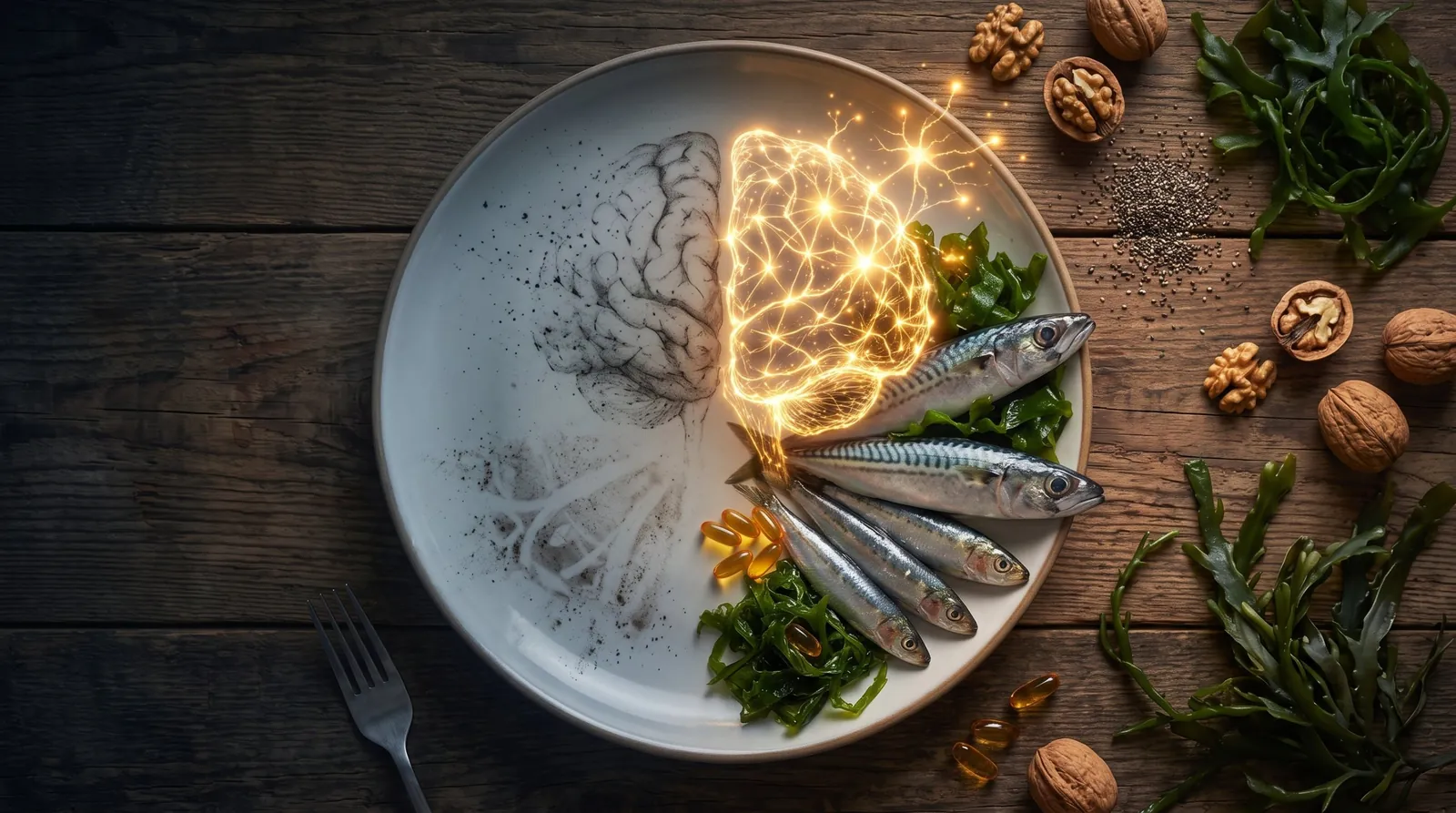
Brain Health
Vegan Omega-3 for Brain Fog: How DHA Clears the Mental Haze
By Mark Howard · Updated 26 October 2026 · 8 min read

You are halfway through a sentence and the word you need just vanishes. You walk into a room and cannot remember why. You read the same paragraph three times and still have not absorbed it. By three in the afternoon, your brain feels like it is running through treacle. This is brain fog, and it is one of the most common — and most frustrating — cognitive complaints among adults over 35. While brain fog has many potential causes, one of the most overlooked is also one of the most fixable: a deficiency in DHA, the omega-3 fatty acid your brain needs to function properly.
What Brain Fog Actually Is
Brain fog is not a clinical diagnosis — it is a collection of symptoms that describe impaired cognitive function. These typically include difficulty concentrating or maintaining focus, short-term memory lapses, mental fatigue or feeling "cloudy," slower processing speed, difficulty finding words, and reduced motivation or mental drive. Brain fog can be triggered by poor sleep, stress, hormonal changes (particularly during perimenopause), dietary deficiencies, and chronic inflammation. For many people, that something is DHA.
The DHA-Brain Connection: Why This Fat Matters
Your brain is roughly 60 percent fat by dry weight, and DHA (docosahexaenoic acid) is the most abundant omega-3 fatty acid in it. DHA is not just present in the brain — it is structurally essential. It makes up a significant portion of the cell membranes in your neurons, and these membranes are where all of your thinking actually happens. Healthy, DHA-rich neuronal membranes are fluid and flexible, allowing signals to pass quickly and efficiently between brain cells. When DHA is insufficient, these membranes become stiffer and less responsive, slowing down the signal transmission that underpins everything from memory retrieval to verbal fluency to sustained attention.
DHA also supports brain health through several other mechanisms — it promotes neuroplasticity (your brain's ability to form new connections), supports the clearance of metabolic waste from brain tissue, modulates inflammation in the central nervous system, and supports healthy blood flow to the brain. When DHA levels are low, all of these processes are compromised. The result is exactly what brain fog feels like: a brain running on insufficient fuel.
What the Research Shows
The strongest evidence comes from people whose intake is low. A six-month randomised controlled trial in 176 healthy adults aged 18–45 with low DHA intake found that 1.16g of DHA a day improved episodic memory in women and the speed of working memory in men, compared with placebo (Stonehouse et al., 2013) — the kinds of cognitive function that brain fog disrupts most.
In older adults with age-related memory complaints, 900mg of DHA a day for 24 weeks improved learning and memory scores compared with placebo (Yurko-Mauro et al., 2010). Results in healthy people who already eat enough omega-3 are less consistent, so the clearest case for DHA is in people whose intake is low — which includes most vegans, whose blood DHA is typically lower than omnivores' (Sarter et al., 2015).
How Much DHA Do You Need for Brain Health?
Most health organisations recommend 250 to 500mg of combined DHA and EPA daily for general health. For targeted cognitive support, the evidence suggests higher intakes may be more effective. The study demonstrating memory improvements used 1,160mg of DHA daily. Other research has suggested that 1,000mg of combined EPA and DHA daily is a reasonable target for cognitive health maintenance.
Our Omega-3 DHA delivers 500mg of DHA per two-softgel serving, from 1,000mg of algae oil. That is above the general 250–500mg recommendation, though below the 900–1,160mg used in the memory trials above. Two servings (four softgels) a day would reach that range; check with your healthcare provider before taking higher doses, especially if you take blood-thinning medication.
Why Algae-Sourced DHA Is the Smarter Choice
If DHA is what your brain needs, does it matter where it comes from? In terms of the molecule itself, no. Algae-sourced DHA is chemically identical to fish-sourced DHA, and research has found they are equally bioavailable (Arterburn et al., 2008) — your body absorbs and uses them the same way. But in terms of what comes along with it, the source matters significantly. Traditional fish oil carries the risk of heavy metal contamination (mercury, lead), persistent organic pollutants (PCBs, dioxins), microplastics, and the infamous fishy aftertaste that causes many people to stop taking omega-3 altogether.
Algae-sourced DHA avoids all of these issues. The algae is grown in controlled, purified environments — sealed from ocean contaminants. The compliance factor is particularly relevant for brain fog: the only supplement that works is one you actually take. If fishy aftertaste has made you quit omega-3 in the past, algae-sourced DHA solves that problem entirely. For a detailed comparison, see our complete guide on why algae-sourced omega-3 is superior to fish oil.
A Complete Approach to Clearing Brain Fog
DHA addresses one of the most common nutritional causes of brain fog, but a comprehensive approach may involve multiple strategies:
DHA for structural brain support. Omega-3 DHA rebuilds and maintains the neuronal membranes your brain needs for clear, efficient signal transmission.
NAD+ for brain energy. Your neurons are among the most energy-hungry cells in your body, and they depend on NAD+ to produce ATP. If brain fog is partly an energy problem, our NMN + Resveratrol supports the cellular energy production that keeps your brain running efficiently.
Sleep and stress management. Both poor sleep and chronic stress deplete brain resources and contribute to cognitive fog. Prioritising these alongside supplementation creates a stronger foundation.
Regular exercise. Physical activity increases blood flow to the brain and supports neuroplasticity. Even moderate daily movement — a 30-minute walk — has measurable cognitive benefits.
The combination of DHA (structural support) and NMN (cellular energy) addresses brain fog from two complementary angles. Many of our customers take both products as part of their daily routine.
Frequently Asked Questions
How quickly can DHA help with brain fog? There is no good evidence for a typical timeline. The trials that found memory improvements ran for six months (Stonehouse et al., 2013) and 24 weeks (Yurko-Mauro et al., 2010), which suggests any benefit builds slowly.
Can omega-3 deficiency really cause brain fog?
Yes. DHA is structurally essential for brain cell membranes, and deficiency impairs the signal transmission that underpins memory, focus, and processing speed. Omega-3 deficiency is one of the most common and most correctable nutritional contributors to cognitive fog.
Is vegan omega-3 as effective as fish oil for the brain?
Clinically, yes. Algae-sourced DHA raises blood DHA levels equally to fish-sourced DHA. The molecule is identical regardless of source. The advantage of algae is the absence of contaminants and aftertaste.
Can I get enough DHA from plant foods like flax or walnuts?
Flax, chia, and walnuts provide ALA (alpha-linolenic acid), a different type of omega-3. Your body can convert ALA to DHA, but the conversion rate is very low — typically under 5 percent. For meaningful brain health support, a direct source of preformed DHA is far more effective.
Should I take DHA with food?
DHA is a fat-soluble nutrient, so taking it with a meal that contains some dietary fat can improve absorption. A meal with avocado, nuts, olive oil, or eggs is ideal.
This article is for informational purposes and does not constitute medical advice. Persistent brain fog may have multiple causes — consult your healthcare provider if symptoms are severe or ongoing.
References
- Stonehouse W, Conlon CA, Podd J, et al. (2013). "DHA supplementation improved both memory and reaction time in healthy young adults: a randomized controlled trial." Am J Clin Nutr. doi:10.3945/ajcn.112.053371. PubMed ↗
- Yurko-Mauro K, McCarthy D, Rom D, et al. (2010). "Beneficial effects of docosahexaenoic acid on cognition in age-related cognitive decline." Alzheimers Dement. doi:10.1016/j.jalz.2010.01.013. PubMed ↗
- Sarter B, Kelsey KS, Schwartz TA, et al. (2015). "Blood docosahexaenoic acid and eicosapentaenoic acid in vegans: Associations with age and gender and effects of an algal-derived omega-3 fatty acid supplement." Clin Nutr. doi:10.1016/j.clnu.2014.03.003. PubMed ↗
- Arterburn LM, Oken HA, Bailey Hall E, et al. (2008). "Algal-oil capsules and cooked salmon: nutritionally equivalent sources of docosahexaenoic acid." J Am Diet Assoc. doi:10.1016/j.jada.2008.04.020. PubMed ↗
How we choose and check sources: our editorial policy.
Related guides
Continue Reading

March 10, 2026