

August 18, 2026
September 1, 2026 · 8 min read

The largest omega-3 trial ever run in adults over 50 gave 25,871 people 840 mg a day for five years and missed its primary endpoint. VITAL reported a hazard ratio of 0.92 for major cardiovascular events, with a confidence interval crossing 1.00.
That is the headline most articles bury. It is also the right place to start, because it tells you something specific: at the dose most supermarket capsules carry, omega-3 did not shift hard outcomes in a broadly healthy older population.
The useful effects are elsewhere. They are real, they are measurable, and almost all of them need more than 840 mg.
VITAL ran for a median of 5.3 years in adults aged 50 and over. The primary composite endpoint — heart attack, stroke, cardiovascular death — came in at a hazard ratio of 0.92 (95% CI 0.80–1.06).
One secondary endpoint stood out. Total myocardial infarction fell to a hazard ratio of 0.72 (95% CI 0.59–0.90). Stroke sat at 1.04. Cardiovascular death at 0.96.
A single significant secondary endpoint in a trial that missed its primary is a hypothesis, not a result. Treat it as interesting rather than settled.
ASCEND, run in 15,480 adults with diabetes at the same 840 mg dose, reached the same place. Two very large trials, one modest dose, no clear effect on the outcomes that matter most.
So the question is not whether omega-3 does anything. It is which effects survive at which dose.
This is the strongest signal in the literature and the one your GP is most likely to care about. A 2023 dose-response meta-analysis pooled 90 randomised trials in 72,598 people and found a near-linear fall in triglycerides as intake rose.
The size depends on where you start. People with normal triglycerides see little movement. People above roughly 2 mmol/L see meaningfully more, with reductions in the 15–30% range at doses above 2 g a day.
Both large 4 g trials — REDUCE-IT with pure EPA and STRENGTH with EPA plus DHA — reported triglyceride falls near 19%. Those were prescription-strength preparations under medical supervision, not supplements.
If your last panel showed raised triglycerides, this is the effect worth acting on. If it did not, expect very little.
A 2022 dose-response meta-analysis in the Journal of the American Heart Association pooled 71 trials in 4,973 adults. It modelled intake against blood pressure using cubic splines rather than crude dose bands.
The curve peaked between 2 and 3 g a day. At 3 g, systolic and diastolic pressure fell by roughly 2 to 3 mmHg against control.
Pooling 71 randomised trials in 4,973 adults, combined EPA and DHA intake of 2–3 g a day produced the largest blood pressure reduction — about 2–3 mmHg systolic. Below 2 g the effect shrank; above 3 g it did not keep improving. The reduction was larger in people with existing high blood pressure or raised lipids.
Source: Zhang et al., Journal of the American Heart Association, 2022 (71 trials, n=4,973).
Two to three millimetres is not dramatic on its own. Across a population it is not nothing either, and it stacks with the things that move pressure much more — sodium, weight, alcohol, aerobic volume.
The practical read: if blood pressure is your reason for taking it, 500 mg a day is not the dose the evidence used.
Sixty adults aged 60 to 85 took either 3.6 g a day of EPA and DHA or corn oil for six months. Forty-four completed. Thigh muscle volume rose 3.6% against control, grip strength by 2.3 kg, and one-repetition maximum strength by 4.0%.
Those participants were not training. That matters both ways — it makes the signal cleaner, and it leaves open how much is left once you are already lifting four times a week.
Sixty people is a small trial and the confidence interval on muscle volume nearly touched zero (0.2% to 7.0%). Do not build a programme around it. Do note that the dose was 3,600 mg, more than four times what VITAL used.
In 60 adults aged 60–85, six months of fish oil at 3.6 g EPA + DHA daily increased thigh muscle volume by 3.6% (95% CI 0.2–7.0), handgrip strength by 2.3 kg and 1-RM strength by 4.0% versus corn oil. Average isokinetic power rose 5.6% but did not reach significance.
Source: Smith et al., American Journal of Clinical Nutrition, 2015 (n=60, 44 completed).
Two trials in over 5,000 adults found no cognitive effect. Three smaller ones found a memory benefit. The difference tracks who was enrolled rather than how much they took.
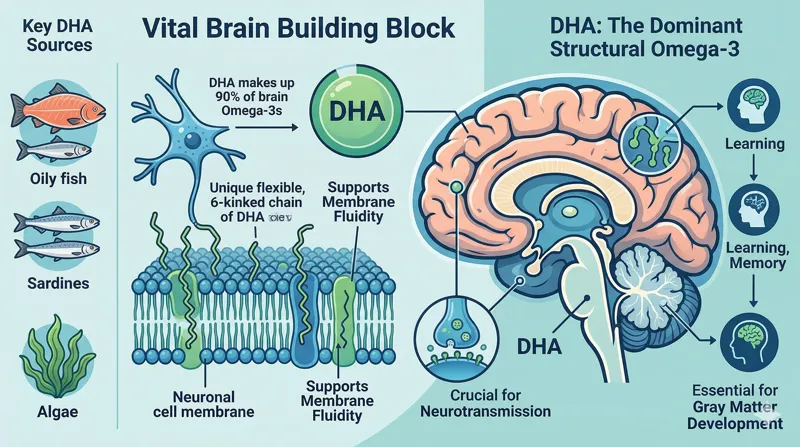
We have written that comparison out in full in DHA and memory: what the trials in healthy adults found. The short version is that baseline status does most of the work — people who already eat oily fish twice a week have little room to move.
If you want the mechanistic difference between the two fatty acids, DHA vs EPA covers where each one ends up and what it does there.
For cognition, the honest position is that the evidence does not support a confident recommendation at any dose.
Five rungs, each anchored to something real.
250 mg a day of combined EPA and DHA is the GB claim level for normal heart function. A product below that cannot legally carry the wording.
840 mg is what VITAL used, and roughly what a standard one-a-day capsule delivers.
2,000–3,000 mg is where the blood pressure curve peaks and where triglyceride reductions become substantial. 3,600 mg is the muscle trial.
EFSA concluded in 2012 that supplemental EPA and DHA combined up to about 5 g a day raises no safety concern for adults. Its 2026 opinion kept a separate safe level of 1 g a day for DHA taken alone.
Pick your rung from the outcome you care about, not from what happens to be on the shelf.
A 2021 meta-analysis in Circulation pooled 7 cardiovascular outcome trials covering 81,210 people, mean age 65. Omega-3 supplementation carried a hazard ratio of 1.25 for atrial fibrillation (95% CI 1.07–1.46).
It was dose-dependent. Above 1 g a day the hazard ratio was 1.49 (1.04–2.15). At or below 1 g it was 1.12 (1.03–1.22). Meta-regression put the increase at 11% per additional gram.
This is the trade-off nobody selling omega-3 wants to print. The doses that produced the blood pressure and triglyceride effects sit in the same range as the arrhythmia signal. If you have a history of atrial fibrillation, palpitations or an implanted device, take the dose question to your GP before you take it to a shopping basket.
Absolute numbers keep this in proportion: across those trials the events were uncommon. But a 25% relative increase is not noise, and you should weigh it against a 2 mmHg blood pressure change rather than against a marketing promise.
The NHS advises at least two portions of fish a week, one of them oily — salmon, mackerel, sardines, herring, trout. A portion is around 140 g.
One 140 g portion of oily fish supplies roughly 2,000 to 3,000 mg of EPA and DHA, which spreads to around 300 to 450 mg a day. Two portions doubles that.
Most UK adults do not eat this much. If you already do, your supplement is topping up a diet that has already cleared the claim level, and the case for a high dose weakens.
Work out your weekly fish intake first. Then decide what number you are actually trying to reach.
Read the EPA and DHA line, not the capsule weight. A "1,000 mg fish oil" capsule usually carries about 300 mg of combined EPA and DHA. Three of those to reach a gram is a different price per day than the front of the box suggests.
Check the form. Triglyceride and re-esterified triglyceride forms absorb better than ethyl esters, particularly when taken without fat. Take it with your largest meal either way.
Check oxidation if the brand publishes it — TOTOX is a combined measure of how far an oil has degraded, and lower is better. Algal oils skip the fish supply chain entirely, which sidesteps both marine contaminants and most rancidity questions. Our own algae-derived omega-3 is built on that logic.
Then pick a dose off the ladder, take it for twelve weeks, and retest whatever it was you were trying to change. That last step is the one most people skip.
August 18, 2026
August 17, 2026