
August 27, 2026
September 10, 2026 · 8 min read

Across 116 adults randomised to a 16:8 eating window or three structured meals a day, the difference in weight after 12 weeks was 0.26 kg. It was not statistically significant.
That is the TREAT trial. It is the most-cited result in this field, and it is not the one that should worry you. The DXA scans are.
Most time-restricted eating research compares a window against nothing. That tests the calorie cut, not the clock. Two trials did better.
TREAT randomised 116 adults with overweight or obesity. One arm ate freely between noon and 8pm. The other ate three meals across the day. After 12 weeks the window group had lost 0.94 kg and the control group 0.68 kg. The between-group difference was 0.26 kg, with a confidence interval running from a 1.30 kg advantage to a 0.78 kg disadvantage.
Fasting glucose, insulin, HbA1c and lipids did not move in either arm.
The second trial ran for a year. Liu and colleagues gave 139 adults with obesity the same calorie prescription — 1,500 to 1,800 kcal for men, 1,200 to 1,500 for women. Half were also confined to an 8am to 4pm window. At 12 months the window group had lost 8.0 kg and the calorie-only group 6.3 kg. The difference was not significant.
Two well-run trials, 255 people, twelve weeks and twelve months. Neither found the window adding anything on top of the calories.
The cleanest test came in 2024. Maruthur's group fed every meal to 41 adults with obesity and either prediabetes or diet-controlled diabetes. Both arms received identical calories and identical nutrients for 12 weeks.
One arm ate within 10 hours, with 80% of intake before 1pm. The other spread food across 16 hours or more, with at least half of it after 5pm.
The window group lost 2.3 kg. The control group lost 2.6 kg. The difference was 0.3 kg, in favour of the controls, with an interval from -1.2 to 1.9 kg. Fasting glucose, HOMA-IR and glycated albumin were no different.
Forty-one people at one site is small, and 93% of them were women. But the design answers the question people keep asking. Hold calories still and the clock stops moving the scale.
If a window works for you, it works because you eat less inside it.
Fifty of the TREAT participants had body composition measured properly. This is the part that matters to anyone who trains.
The 16:8 group lost 1.70 kg in the clinic measurements. Of that, 1.10 kg was lean mass. Only 0.51 kg was fat, and the fat change was not statistically significant.
Appendicular lean mass — arms and legs, the part that carries a shopping bag and a barbell — fell 0.64 kg in the window group against 0.17 kg in controls. That between-group gap was 0.47 kg, p=0.009.
The authors offer the obvious explanation. Ad libitum eating in a short window cuts calories, and it cuts protein with them. Protein intake was not measured in the trial, which is a real limitation.
Fifty adults, DXA at baseline and 12 weeks. The 16:8 arm lost 1.70 kg, of which roughly 65% was lean tissue. Loss of lean mass during weight loss usually accounts for 20-30%. Appendicular lean mass fell significantly more in the window arm than in controls.
Source: Lowe et al., JAMA Internal Medicine, 2020 (in-person cohort, n=50).
Parr's group in Melbourne tested the mechanism directly. Eighteen men, average age 46, ate matched calories and matched protein for 10 days. One group ate across 8 hours, the other across 12.
They measured myofibrillar protein synthesis with deuterium oxide — heavy water, which tags newly built muscle protein over days rather than the few hours an infusion study can capture.
Synthesis rates were identical. The window did not slow muscle building. Lean mass still came down about 1 kg in the 8-hour group, but all of it from the trunk, with no loss in any limb. Twenty-four-hour glucose was better in the window group.
One number in that study deserves attention. Protein was set at 1 g per kg of body weight. That is a maintenance dose, not a training one.
Pooled data agree with the mechanism. Ho and colleagues combined seven trials in 164 adults who lifted weights. Compared with the same training on a normal eating pattern, adding a window took off 2.90 kg of body mass and 1.52 kg of fat. Fat-free mass, muscle cross-sectional area and upper and lower body strength showed no difference at all.
Total cholesterol fell 9.44 mg/dL and LDL 9.94 mg/dL in the same analysis.
Feed yourself properly and train, and the window costs nothing measurable. Skip either and it does.
Where the window sits looks more important than how long it is.
Jamshed randomised 90 adults with obesity for 14 weeks. Everyone ate 500 kcal below their resting energy expenditure and exercised 75 to 150 minutes a week. One arm ate between 7am and 3pm. That arm lost 2.3 kg more, with an interval from 0.9 to 3.7 kg.
Fat loss was 1.4 kg greater but did not reach significance. Diastolic blood pressure fell 4 mmHg further. Fatigue, vigour and low mood scores improved.
Sutton's controlled feeding study is the mechanistic one. Eight men with prediabetes ate within 6 hours, finishing by 3pm, for five weeks, then crossed over to a 12-hour schedule. Food and body weight were held constant. Insulin sensitivity, beta-cell responsiveness, blood pressure and oxidative stress markers all improved on the early schedule.
Eight men. Treat it as a signal about mechanism, not a result you can bank — the same problem that runs through most small supplement trials.
The reverse experiment points the same way. Vujović's crossover in 16 adults took identical meals and moved them four hours later. Late eating raised hunger, lowered leptin across 24 hours, reduced waking energy expenditure and shifted adipose tissue gene expression towards storage. Only five participants were women.
Pooled across 13 randomised trials in 859 adults, early windows produced 1.84 kg of weight loss, 1.10 kg of fat loss and 3.21 cm off the waist. Fat-free mass fell 0.56 kg, which just missed significance at p=0.06.
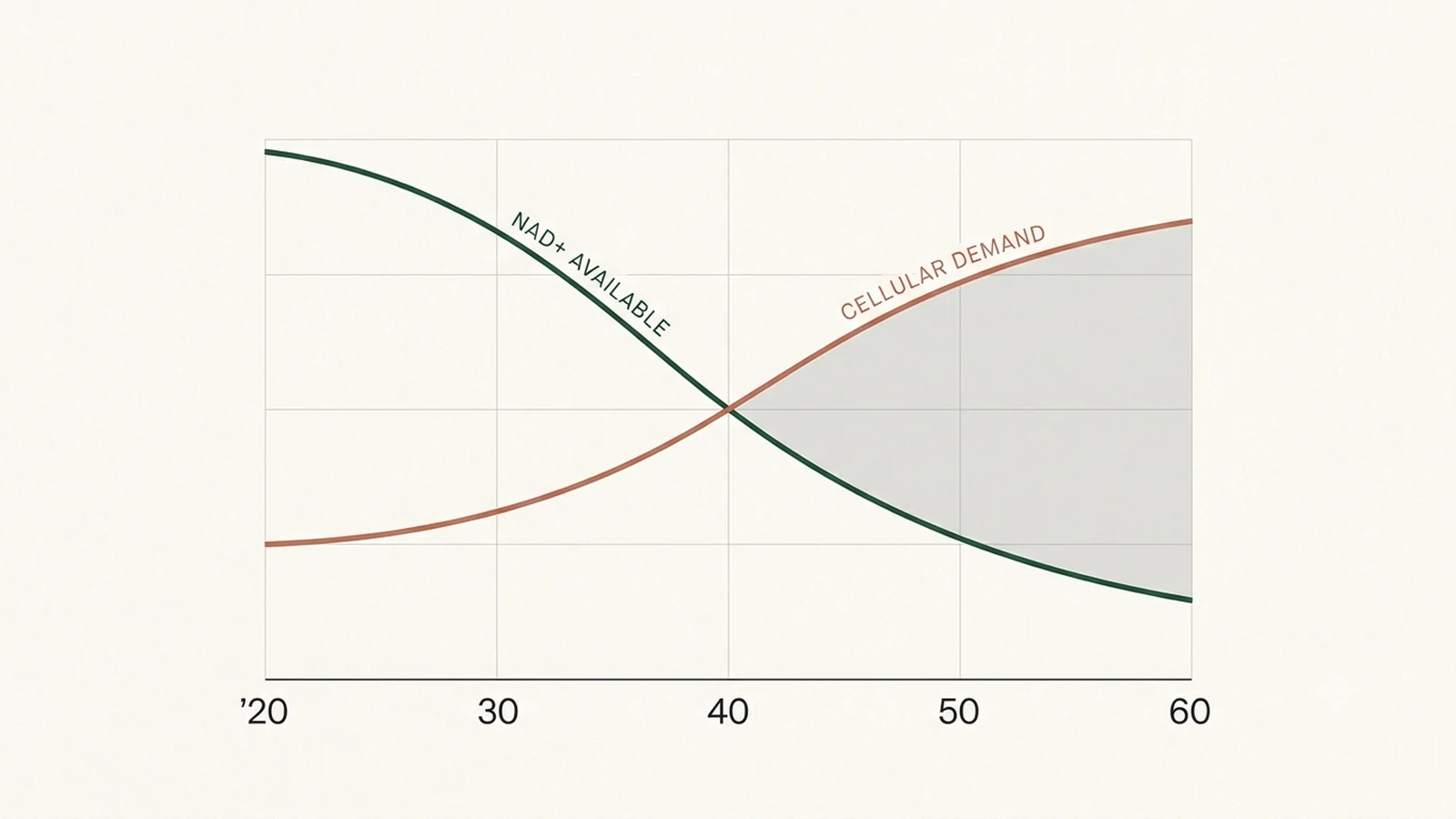
Nothing here supports skipping breakfast and eating at 10pm. If you want the timing effect, it lives in the morning. That is the same body clock that governs NAD+ across the day.
Six things the data supports.
Choose 16:8 or 14:10, not four or six hours. A four-arm trial in 41 adults found 16:8 reduced fat mass by 8.65% over eight weeks while 14:10 and 12:12 changed nothing. Shorter than eight hours is where lean loss appears.
Put the window early. An 8am to 6pm window captures most of the timing effect and still lets you eat dinner with people.
Hit protein first, then fill in. At 75 kg and training four times a week, 1.6 g per kg is about 120 g a day. Inside eight hours that means three meals of roughly 40 g, not two of 60 g.
Train inside the window, or eat within a couple of hours of finishing. Fasted evening sessions followed by nothing until noon are the worst combination in this literature.
Do not stack a short window on a steep deficit and hard training. That combination is where the appendicular lean mass went.
Track something other than weight. A tape measure round the waist, and your top sets. Two weeks of falling bar speed is data.
If you take medication with food, or anything for blood glucose, speak to your GP before compressing your meals. And if you are watching a blood panel, know what HbA1c is and is not telling you before you judge the experiment.
On weight, the window adds nothing beyond the calorie cut. Three trials designed to isolate it agree.
On adherence, it can help. Some people eat less without counting anything, and that is the whole mechanism.
On muscle, the risk is real but conditional. Low protein and a very short window cost lean mass. Adequate protein and resistance training appear to cost nothing.
On timing, earlier looks better, and the trials showing it are smaller than the trials showing nothing.
Nobody has run this for five years in trained 55-year-olds. Anyone telling you what it does to your healthspan is guessing, and you should read them accordingly. Our own view is the same one we take on NMN and resveratrol: report the effect size, name the sample, and say plainly where the evidence runs out.
August 27, 2026
August 8, 2026