

April 4, 2026
August 27, 2026 · 8 min read
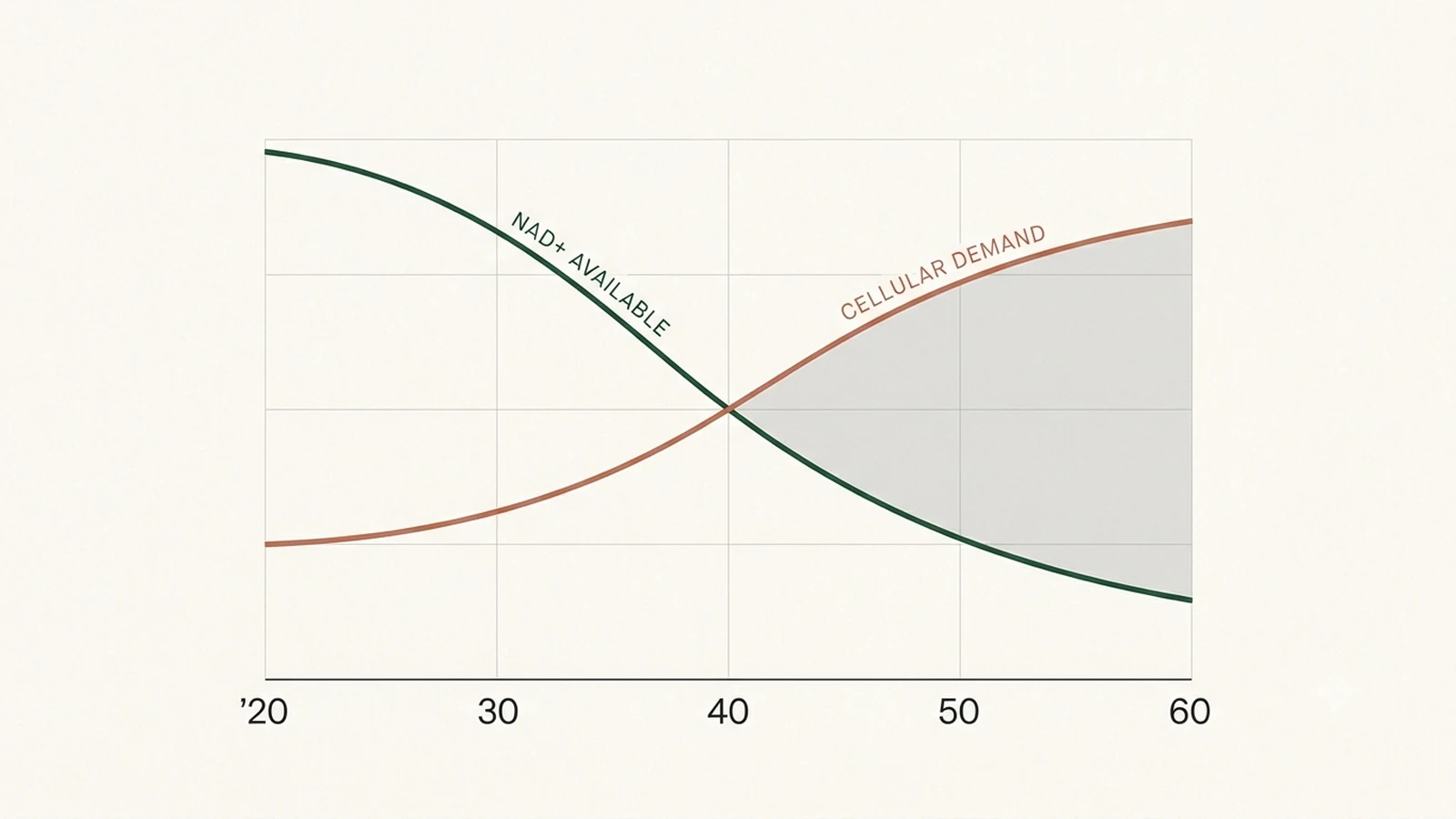
Shift ten healthy adults twelve hours out of phase and their fasting insulin rises 22%. Leptin drops 17%. Glucose climbs 6%, and the daily cortisol curve flips upside down.
Nobody changed what they ate. Only when they ate and slept changed.
That trial is the sharpest human evidence for something the mouse literature has said since 2009: your body clock is not a sleep scheduler bolted onto your metabolism. It is part of the metabolism. And the molecule sitting at the junction is NAD+.
Two papers landed in Science on the same day in 2009. Both found the same loop from different ends.
NAMPT is the rate-limiting enzyme of the NAD+ salvage pathway — the route that recycles nicotinamide back into usable NAD+. Ramsey and colleagues showed that CLOCK:BMAL1, the two transcription factors at the core of the mammalian clock, bind the Nampt gene and drive it on a 24-hour cycle. NAD+ levels then rise and fall behind it.
Nakahata and colleagues closed the circle. SIRT1 needs NAD+ to work. When NAD+ is high, SIRT1 deacetylates the clock proteins and damps their own transcription. So the clock builds NAD+, and NAD+ feeds back on the clock.
It is a genuinely elegant piece of biology. It is also entirely mouse. Nobody has shown a clean, measurable NAD+ oscillation running the same way in a living human, and that gap matters for everything below.
Scheer and colleagues put ten adults on a forced 28-hour day for ten days. That schedule slides sleep and meals steadily around the clock, so each participant eventually eats and sleeps roughly twelve hours out of phase with their own internal timing.
Under 12-hour misalignment, fasting glucose rose 6% and insulin rose 22%, despite the higher insulin. Leptin fell 17%. Mean arterial pressure rose 3%. The cortisol rhythm reversed completely. Three of the ten participants met the criteria for a prediabetic glucose response.
Source: Scheer et al., PNAS, 2009 (n=10).
Ten people, ten days, a laboratory. You cannot read population risk off that. The epidemiology points the same way, though. A meta-analysis of 12 studies covering 226,652 participants and 14,595 diabetes cases found a pooled odds ratio of 1.09 for ever having worked shifts. Among men it was 1.37.
An odds ratio of 1.09 is small. It is also averaged across everyone who ever clocked a night shift, which is a blunt exposure measure. The honest reading: chronic misalignment nudges risk, and the nudge is bigger than zero.
Möller-Levet and colleagues gave 26 people a week of restricted sleep, then a week of sufficient sleep, in a controlled crossover. Restricted meant 5.70 hours per 24. Sufficient meant 8.50.
Blood was sampled with light, food and activity controlled. After one week of short sleep, 711 genes had changed expression. The affected genes clustered in chromatin remodelling, transcriptional regulation, and immune and stress response.
The more interesting result was not which genes moved. It was the loss of shape. Insufficient sleep reduced the amplitude of circadian rhythms in gene expression. The oscillation flattened.
That is a general finding about the human clock, not about NAD+ specifically. But it tells you the machinery driving NAMPT in mice is measurably blunted in humans by a single week of the sleep most people over 50 are actually getting.
Broussard and colleagues ran seven healthy young adults through four nights at 4.5 hours in bed and four nights at 8.5 hours, with calories and activity held constant.
Total-body insulin sensitivity fell 16% after four nights at 4.5 hours in bed. In subcutaneous fat biopsies, Akt phosphorylation — an early step in the insulin signalling cascade — was markedly impaired.
Source: Broussard et al., Annals of Internal Medicine, 2012 (n=7).
Seven participants is very small, and they were young — mean age 23.7. The value is mechanistic. It shows where the whole-body effect comes from, at the level of the fat cell.
The counterpart runs in the other direction. Tasali and colleagues randomised 80 adults with overweight who habitually slept under 6.5 hours. A single personalised sleep-hygiene session added 1.2 hours of sleep per night on average. Objectively measured energy intake fell by about 270 kcal a day over two weeks, with no change in energy expenditure.
Two weeks is short and 80 people is modest. Still, 270 kcal a day is a real number, obtained by sleeping rather than by dieting.
Here is where the story gets less flattering to our own category.
Cuenoud and colleagues used 7-tesla phosphorus magnetic resonance spectroscopy to measure NAD in the occipital brain of 25 healthy participants, in the morning and again in the afternoon. Salivary cortisol confirmed the two sessions caught genuinely different physiological states.
Brain NAD did not differ significantly between morning and afternoon. Neither did lactate or most other metabolites measured. Taurine was the exception.
One region, one imaging method, two time points — this does not disprove a human NAD+ rhythm. Circadian oscillation of NAD has been reported in human red blood cells but not in whole blood, which hints the signal is real but compartment-specific. What it does mean is that anyone telling you your NAD+ "peaks at night" is extrapolating from mouse liver. Treat that claim as a hypothesis.
One trial has asked directly. Kim and colleagues randomised 108 Japanese adults aged 65 and over into four arms: 250 mg of NMN before noon, 250 mg after 18:00, and matching morning and evening placebos, for 12 weeks.
The evening NMN group posted the largest within-group effect sizes across the board: sleep quality score d = 0.80, daytime dysfunction d = 0.72, PSQI global score d = 0.68, drowsiness d = 0.64, five-times sit-to-stand d = 0.72.
Now the caveats, because they are load-bearing. There was no statistically significant group-by-time interaction for sleep quality on the PSQI. The evening placebo group also improved its drowsiness score significantly. The authors themselves flag a probable placebo effect and note that sleep was measured by questionnaire, not actigraphy or polysomnography.
Across 108 adults aged 65 and over, 12 weeks of 250 mg NMN produced the largest effect sizes when taken after 18:00. The between-group interaction for sleep quality was not significant, and the evening placebo group improved on drowsiness as well.
Source: Kim et al., Nutrients, 2022 (n=108).
A 2024 trial adds a little. Morifuji and colleagues gave 60 older adults 250 mg a day for 12 weeks. Blood NAD+ and its metabolites rose significantly against placebo. Walking speed held steady in the NMN group while it declined in the placebo group, and sleep quality improved as a secondary endpoint. Secondary endpoints are hypothesis-generating, not conclusive.
So: two small trials, one timing comparison that missed significance, and a plausible mouse mechanism. If you already take NMN, moving it to the evening costs nothing. That is the strongest recommendation the evidence supports.
Fix your wake time first. It anchors the clock more reliably than bedtime does, because morning light is the dominant signal and you can only catch it by being awake for it. Get outside within an hour of waking, without sunglasses. Ten minutes on a grey British morning still beats indoor lighting by an order of magnitude.
Aim for the NHS window of 7 to 9 hours, and use daytime tiredness rather than a tracker score as your check. Sleep need does not fall much with age. The ability to hold it in one block often does.
Move your hard sessions earlier where you can. NHS guidance suggests avoiding exercise in the four hours before bed. If you train in the evening because that is when life allows it, the trade is usually still worth making — just expect a longer wind-down.
Eat your last substantial meal earlier. Late eating has been shown in crossover trials to blunt glucose tolerance and flatten the daily cortisol profile, independent of what is on the plate.
If you supplement, take NMN in the evening. The evidence is one non-significant timing comparison, and it is free to act on. Our NMN dosage guide covers the amount question, which is far better characterised than the timing one, and what NAD+ actually does covers the molecule. If you are wondering why none of this feels like a stimulant, that is the point.
The dose on our own NMN + Resveratrol label is 500 mg, with 600 mg of trans-resveratrol. Both trials above used 250 mg. We are not going to pretend the timing question is settled by them.
And if sleep has been broken for three months or more, that crosses the NHS threshold for long-term insomnia. That is a conversation with your GP, not a supplement decision. No capsule in our range is a substitute for that appointment.
The clock is the cheapest lever in this entire article. It costs nothing, it works on everyone, and unlike NAD+ precursors, the human evidence is not thin.
April 4, 2026

July 25, 2026