August 25, 2026
September 18, 2026 · 7 min read
The dose was 750 mg, infused over six hours at about 2 mg a minute. No stomach, no gut wall, no liver to get past first. The friendliest possible conditions.
The researchers worked out what should have happened. Spread through a five-litre blood volume, plasma NAD+ should have risen by at least 18 micromolar every thirty minutes.
It rose by nothing. Not at thirty minutes, not at sixty, not at two hours. Their mass spectrometry could easily have detected a change that size. There was no change to detect.
That is the central fact about taking NAD+ directly, and it was demonstrated with the gut removed from the equation entirely.
Eleven healthy men aged 30 to 55 were randomised to 750 mg of NAD+ intravenously over six hours, or saline. Plasma NAD+ and its metabolites did not shift at all until after the two-hour mark. The authors concluded the infused molecule was being removed from plasma completely as fast as it arrived.
Source: Grant et al., Frontiers in Aging Neuroscience, 2019 (n=11, 8 infused).
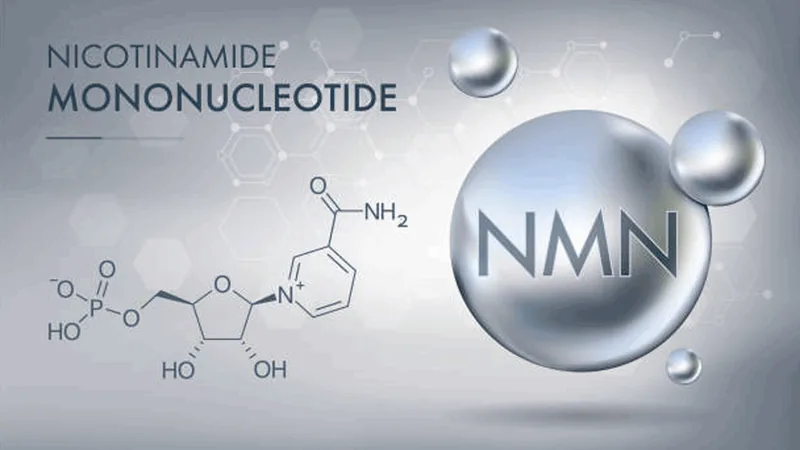
NAD+ weighs 663 daltons. It carries two phosphate groups and a net negative charge at blood pH. Charged molecules that size do not diffuse through a lipid bilayer. They need a transporter, and no well-characterised human transporter for intact NAD+ exists.
Now compare what it is made of. Nicotinamide is 122 daltons and moves fairly freely. Nicotinamide riboside, in its nucleoside form, is 255. NMN sits between at 334, and carries a phosphate of its own — which is exactly why NMN has its own absorption argument.
Human blood shows the consequence. In the first pharmacokinetic study of oral nicotinamide riboside, every phosphorylated compound measured — NAD+, NMN, NADP+, NAAD and ADP-ribose — was found only inside blood cells. None of them appeared in plasma. None appeared in urine.
The phosphate group is the doorman. Anything carrying one stays where it was made.
Swallowing NAD+ adds a second problem on top of the first. It has to survive the small intestine.
A 2025 study in mice used labelled NMN and NR to follow both compounds through the gut. Only a small fraction was absorbed intact. Most was cleaved, then deamidated by gut bacteria into nicotinic acid, which the liver used to rebuild NAD+ by a different route.
One of the enzymes doing the cleaving is BST1, which sits on the luminal surface of the small intestine. It hydrolyses nicotinamide riboside to nicotinamide before the molecule has gone anywhere.
Isotope tracing in mice reached the same place seven years earlier. Orally delivered nicotinamide riboside was metabolised to nicotinamide in the liver. The same compounds given intravenously did arrive intact in several tissues. The route decides the fate.
Labelled NMN and NR given by mouth were largely broken down in the small intestine rather than absorbed whole. Gut bacteria converted the fragments to nicotinic acid, which the liver then used. The same molecules given intravenously were degraded to nicotinamide and secreted into bile.
Source: Yaku et al., Science Advances, 2025 (mouse study).
An oral NAD+ capsule is therefore an expensive way to deliver nicotinamide and a sugar. That is mouse work, so treat the mechanism as provisional. The human plasma data points the same way.
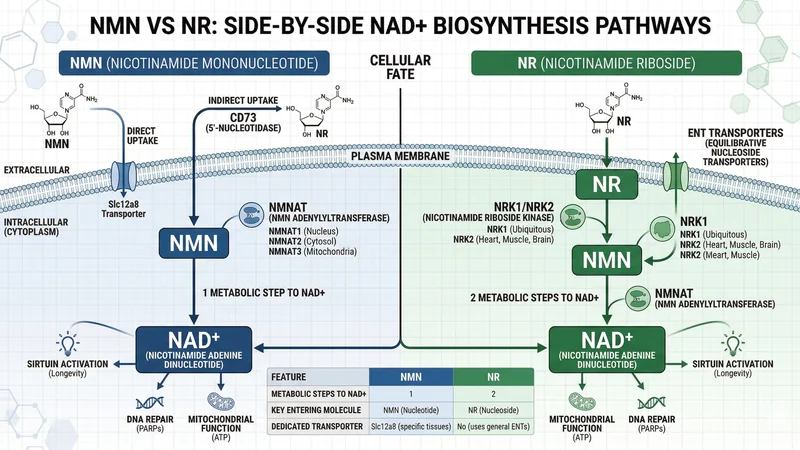
NRK1 is the kinase that turns nicotinamide riboside back into NMN once it is inside a cell. Work in mammalian cells found NRK1 is both necessary and rate-limiting for using either NR or NMN supplied from outside.
The NMN half of that is the interesting part. Using stable-isotope-labelled compounds, the researchers showed NMN loses its phosphate outside the cell and enters as NR. Remove NRK1 and NMN stops working — which it should not do if NMN walked in whole.
There is a counter-argument worth knowing. A 2019 mouse paper described Slc12a8, a transporter in the small intestine said to move NMN directly. Other laboratories have had difficulty reproducing it, and the question is unsettled.
Neither side of that argument proposes a route for intact NAD+. The cell's logic is consistent: break it down outside, carry the pieces in, rebuild inside.
Every NAD+ precursor on sale is a form of vitamin B3. The recommended daily allowance is roughly 15 mg an adult, as nicotinamide or nicotinic acid, and both cost pennies a month.
The nicotinamide riboside trials used 100, 300 and 1,000 mg. That is 2.8, 8.4 and 28 times the RDA. So the real question was never whether B3 raises NAD+ — your dinner does that. It is whether large doses of one particular precursor achieve something the vitamin does not.
Plain nicotinic acid at 500 mg is hard to take. In one randomised trial, 33 of 33 participants flushed, against 1 of 35 on placebo. The newer precursors are argued for partly on that, and tolerability is a real advantage. It is not an outcome.
There is also a reason a blood reading tells you less than it seems to. Isotope tracing shows NAD+ turnover varies enormously between tissues: high flux in the small intestine and spleen, low flux in skeletal muscle. The tissue a 55-year-old lifter cares about is the one with the slowest turnover of all.
An infusion skips the gut completely, which is the entire pitch of the clinics selling it. The 2019 infusion study remains the only published human pharmacokinetic data on it.
By the end of six hours, plasma NAD+ was 398% above baseline. Nicotinamide was up 409%. ADP-ribose was up 393%. Methylnicotinamide was up 350%.
Those fragments are what you get when the bond between nicotinamide and ADP-ribose is cut. The enzymes doing it — CD38 and its relatives — sit on the outer surface of your cells, facing the blood.
Urinary NAD+ excretion rose 538% across the same six hours. Part of the infusion went straight out.
If you are weighing up a clinic, one more thing is worth knowing. Claims made for intravenous vitamin infusions were the subject of three ASA rulings in December 2023, and CAP guidance asks advertisers to hold evidence that the drip delivers something the same nutrients taken by mouth would not. We went through the cost side of this in our piece on NMN versus NAD+ IV drips.
Oral nicotinamide riboside does raise blood NAD+. In eight healthy volunteers titrated up to 1,000 mg twice daily, whole blood NAD+ roughly doubled across seven days. That part is settled.
The next part is not. A 2024 meta-analysis pooled eight randomised trials covering 342 middle-aged and older adults, on NMN at 250 to 2,000 mg a day for two to twelve weeks. It found no significant effect on fasting glucose, fasting insulin, HbA1c, HOMA-IR or lipids.
One 25-woman trial in prediabetic postmenopausal women did find improved muscle insulin sensitivity on 250 mg of NMN for ten weeks. It is small, and it stands fairly alone.
So the substrate rises reliably and the outcomes have not followed. We sell an NMN product, and that is still what the pooled evidence says.
Three practical points.
Do not buy anything sold as NAD+ itself — capsule, sublingual spray or liposome. No published human pharmacokinetic study shows intact NAD+ from an oral product reaching the blood. You would be paying a premium for a molecule that gets cut apart either in your gut or at your cell surface.
If you want to raise NAD+, the precursors are where the human data sits. Nicotinamide riboside has the cleanest pharmacokinetics; NMN has more outcome trials, though not better ones. Study doses cluster between 250 and 1,000 mg a day. The difference between the two is smaller than the marketing suggests, and both are covered on our NMN + Resveratrol page.
Then judge every claim by what it measured. "Raises NAD+ by X%" is a substrate reading, and easy to produce. "Improved walking distance" or "improved insulin sensitivity" is the harder claim, and far rarer. Ask which one you are being sold, because the gap between them is where most of the money in this category is made.
August 25, 2026
August 29, 2026