April 4, 2026
August 29, 2026 · 8 min read
Twelve men in their seventies took 1 g of nicotinamide riboside a day for three weeks. Their whole-blood NAD+ more than doubled. Their muscle NAD+ moved from 197 to 210 pmol/mg, p=0.22 — which is to say, it did not move at all.
That single result from Elhassan and colleagues at Birmingham is the most useful thing anyone has published on this question. It reframes the whole NMN-versus-NR argument. The interesting question is not which molecule survives your stomach. Both do. The question is what happens after that.
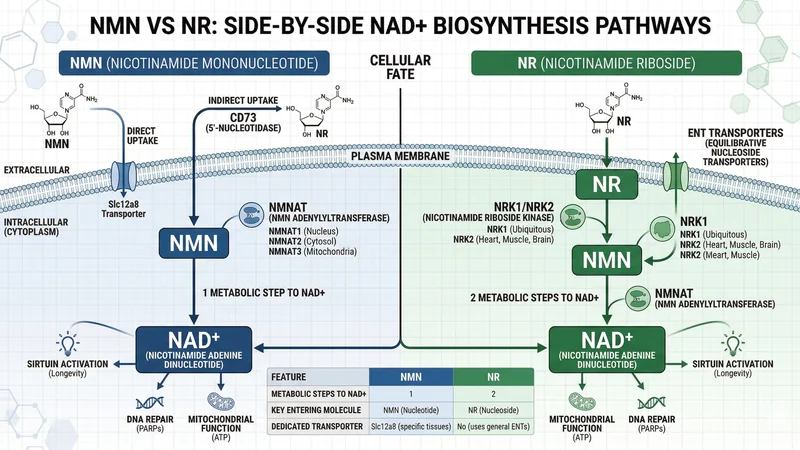
NMN and NR are one phosphate group apart. NR is the riboside; NMN is NR with a phosphate bolted on. Inside the cell, an enzyme called NRK1 phosphorylates NR to NMN, and NMNAT enzymes finish the job into NAD+.
So the destination is identical. The argument is about the door.
Phosphate groups are charged, and charged molecules do not cross membranes unaided. That is the structural fact underneath the entire debate. NR, being uncharged, slips through nucleoside transporters that already exist on every cell.
If you take nothing else from this piece, take that: the two compounds converge before they do anything.
In 2016 Ratajczak and colleagues published the experiment that set the terms. Using stable isotope-labelled compounds in mammalian cells, they traced where the label went.
NMN was dephosphorylated outside the cell, taken up as NR, then rebuilt into NMN on the inside. Knock out NRK1 and neither precursor works. Their conclusion was blunt: NRK1 is rate-limiting and essential for both, which makes NR and NMN "convergent NR supplementation strategies".
Isotope-labelled NMN applied to mammalian cells was dephosphorylated extracellularly to NR before uptake. Cells lacking the NRK1 enzyme could not use either precursor to make NAD+.
Source: Ratajczak et al., Nature Communications, 2016 (cell and mouse work).
Three years later, Grozio and colleagues proposed a counter-route. They identified Slc12a8, a sodium-dependent transporter expressed in the mouse small intestine, and reported that it carries NMN directly — and specifically not NR.
Schmidt and Brenner then published a formal challenge in the same journal, arguing the analytical methods and transport data did not support the assignment. That exchange has never been resolved. Brenner is chief scientific adviser to ChromaDex, which sells NR, and declared it; you should weigh the dispute knowing that.
Either way, the transporter work is mouse gut. Nobody has demonstrated a direct NMN transporter in human tissue.
Blood is easy to measure and everyone measures it. Both precursors raise blood NAD+, and neither result is in dispute.
In the Birmingham trial, whole-blood NAD+ went from 20.9 µM on placebo to 47.75 µM on NR, p<0.001. Blood NAAD — a side branch that rises when NAD+ synthesis speeds up — went up 4.5-fold. NMN in blood rose 1.4-fold.
For NMN, the 2024 meta-analysis by Chen and colleagues pooled eight randomised trials covering 342 middle-aged and older adults at 250 to 2,000 mg a day. Blood NAD+ rose. Fasting glucose, fasting insulin, HbA1c, HOMA-IR and the lipid panel did not.
So both molecules clear the gut and reach circulation. Absorption, in the ordinary sense, is settled.
Irie and colleagues gave ten healthy Japanese men single oral doses of NMN at 100, 250 and 500 mg, then sampled blood for five hours after each. Nothing concerning turned up: no symptom, no shift in temperature, oxygen saturation, blood pressure or heart rate, and no change on ophthalmic or neurological examination.
What did turn up is the interesting part. The compounds that rose dose-dependently in plasma were methylnicotinamide and the pyridone metabolites 2-PY and 4-PY — the end products of nicotinamide disposal, not NMN itself.
That is the shape of NAD+ precursor pharmacokinetics in humans. You give a phosphorylated molecule and you measure, hours later, the things the liver made of it.
Trammell and colleagues found the same pattern for NR in 2016, tracking it into the human NAD+ metabolome rather than watching NR persist in circulation. Neither precursor floats around intact waiting to be collected by muscle.
Treat any brand claim about a precursor "arriving intact at the cell" as unmeasured.
The Birmingham team biopsied quadriceps at baseline and after each arm. Muscle NAD+ was 210 pmol/mg on NR against 197 on placebo — no change.
Muscle NAAD did double, from 0.35 to 0.73 pmol/mg, p=0.004. Methylated clearance products rose five-fold. So the molecule reached the tissue and the disposal machinery noticed. The NAD+ pool itself stayed put.
Function followed the pool, not the metabolites. Mitochondrial respiration by high-resolution respirometry: unchanged. Citrate synthase activity: unchanged. Mitochondrial copy number: unchanged. Grip strength 32.5 kg on NR against 34.7 kg on placebo, p=0.96.
The same team then measured muscle and brain NAD+ by phosphorus-31 magnetic resonance spectroscopy — a scan that reads tissue chemistry non-invasively — in 16 young and 11 older adults. No difference between the age groups.
That last finding deserves more attention than it gets. If healthy older muscle is not NAD+-depleted, there is nothing there for a precursor to top up. Read more on what NAD+ does and why the decline story is more complicated than it looks.
NMN's best human result is Yoshino and colleagues in Science, 2021. Twenty-five postmenopausal women with prediabetes and obesity took 250 mg of NMN or placebo for ten weeks.
Insulin-stimulated glucose disposal, measured by hyperinsulinaemic-euglycaemic clamp — the reference method, where insulin and glucose are infused at controlled rates to isolate how much glucose muscle takes up — rose on NMN and did not change on placebo. Muscle AKT and mTOR phosphorylation increased in line with it.
That is a real, clamp-verified, muscle-level effect at a modest dose. It is also 25 women, one site, one population, never replicated.
Hold both facts at once. It is the strongest signal in the field and it is a single small trial.
Here is the pattern that should shape how you read any absorption claim.
Dollerup and colleagues gave 2,000 mg of NR daily for 12 weeks to 40 obese, insulin-resistant men. No effect on insulin sensitivity, mitochondrial function or metabolic flexibility. Eight times the dose of the Yoshino NMN trial, and less to show for it.
Populations differed, endpoints differed, and you cannot compare across trials cleanly. But if absorption were the bottleneck, more milligrams would buy more result. They did not.
Stop paying for dose. Start reading the outcome.
Nicotinamide riboside chloride is an authorised novel food in Great Britain, listed as NOVEL-96, capped at 300 mg a day for adults and 230 mg a day in pregnancy or breastfeeding.
That cap is below every NR trial discussed here. The Birmingham trial used more than three times it; Dollerup used nearly seven times. A legal UK NR supplement cannot deliver the trial dose.
NMN sits in a different position. It has no GB authorisation. An application from Effepharm, RP-2116, is at the risk assessment stage, and products already on the market may remain there while the assessment runs. We cover how the novel foods process works and what it means for buyers separately.
Practically: if you buy NR in the UK you get at most 300 mg. If you buy NMN you get whatever the brand chose, under a framework still being decided.
Absorption is the wrong axis. Both precursors reach the blood, both converge on NRK1, and neither has been shown to raise resting muscle NAD+ in a healthy older adult.
So decide on the things that are actually knowable. Price per gram of active, not per capsule — a 60-capsule pot at 250 mg is 15 g, and a 30-capsule pot at 300 mg is 9 g. A batch certificate of analysis you can read. A dose that matches a trial rather than a marketing round number.
And keep the effect sizes in view. One 25-person trial found a clamp-measured improvement in muscle insulin sensitivity. A meta-analysis of 342 people found nothing on glucose, insulin, HbA1c or lipids. Both of those are true, and the second one is bigger.
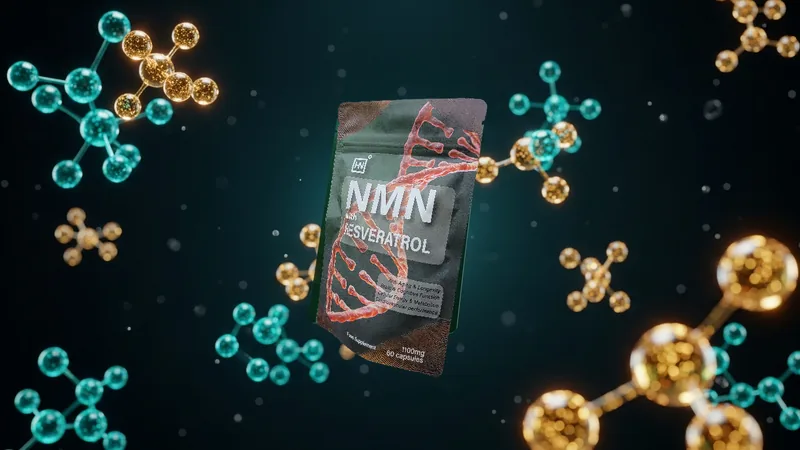
If you want the honest version of what we sell: our NMN and resveratrol formulation is built on that thin evidence base, and we would rather you knew it before you bought it than after. If a brand tells you their precursor has superior cellular uptake, ask which human trial measured that. There isn't one.
April 4, 2026

August 25, 2026