
April 4, 2026
August 22, 2026 · 8 min read

The statute gives the risk assessor nine months. Across 292 dossiers, the average run from submission to a published opinion was 935 days.
That is European Food Safety Authority data, published last year. Great Britain runs the same inherited statute, with the Food Standards Agency in the assessor's chair. So the shape of the delay is the shape of ours.
If you buy supplements in the UK, this process decides what is on the shelf. It is worth understanding properly.
A novel food is anything not eaten to a significant degree in the UK or EU before 15 May 1997. That date is the whole test. It is written into assimilated Regulation (EU) 2015/2283 and it does not move.
Three kinds of thing fall inside it. Genuinely new ingredients, such as the phytosterols in cholesterol-lowering spreads. Foods eaten elsewhere but not here, such as chia seeds and baobab. And familiar foods made by a new process, such as bread treated with ultraviolet light to raise its vitamin D.
Nothing about novelty implies danger. It implies an absence of evidence from long use, which the law asks someone to replace with data.
The burden sits with the business, not the regulator. The FSA is explicit that it will not answer informal questions about whether a product is novel.
There are two routes to authorisation, and they are not equally hard.
Article 10 is the full application. The dossier runs to three parts: administrative data, then the substance itself, then the evidence. Part two alone covers identity, production process, composition, specifications, history of use, proposed intake, absorption and metabolism, nutritional data, toxicology and allergenicity.
Article 14 is the traditional food notification. It is open to foods eaten outside the UK and EU for at least 25 continuous years. The data requirements are lighter, and the FSA has four months to raise safety objections. If it raises none, the food is authorised.
If it does object, the applicant can go again under Article 16 with the specific gaps filled. That is the fallback, not the shortcut.
Le Bloch and colleagues pulled every novel food application submitted to EFSA between 2018 and 2024. That is 292 dossiers, with each stage timed from public records.
The validation phase came first, and it is the part nobody talks about. Verification took 114 days on average. The suitability check took another 185. Together, 299 days passed before the scientific assessment even started.
The assessment itself averaged 629 days against a nine-month legal limit. Twenty-six per cent of dossiers formally overran that limit, by an average of 156 days.
Here is the honest part. Applicants, not assessors, consumed 47% of the evaluation clock. The average dossier drew 2.7 requests for extra data, and applicants took 130 days to answer each one.
So the delay is shared. Half of it is regulatory capacity. Half of it is dossiers arriving thinner than the guidance asks for.
Mean time from submission to published opinion was 2.56 ± 1.19 years. Validation ran 299 ± 218 days, scientific assessment 629 ± 338 days, and publication a further 48 ± 16 days. Of 91 completed opinions, 79 were positive — a pass rate of 86.8%.
Source: Le Bloch et al., npj Science of Food, 2025 (n=292 applications submitted 2018–2024).
That pass rate matters. Once a dossier reaches an opinion, it usually clears. The bottleneck is arrival, not judgement.
Before any of that, someone has to decide whether the food is novel at all. That is an Article 4 request, and it is a separate process with its own dossier.
The applicant has to show either that the product falls outside the definition, or that it has a real history of consumption before May 1997. The FSA publishes the outcomes.
Hemp shows how fine the line is. The FSA accepts hemp seeds, hemp seed oil, ground and defatted hemp seeds as not novel, because the consumption record is there. Water infusions of hemp leaves are also not novel, provided the flowering tops are absent.
CBD extract is novel. That was confirmed in January 2019, and adding it to a non-novel oil does not change the answer.
Until recently, a ministerial yes was not the end. Each authorisation then needed a statutory instrument before anything could be sold. The FSA's own estimate was that this added three to six months.
SI 2025/361 ended it. From 1 April 2025, an authorisation takes effect on the ministerial decision and is published in an online register. The same instrument scrapped ten-yearly renewals for feed additives, GMOs and smoke flavourings.
The register at data.food.gov.uk is now the primary legal record, not a convenience copy. It carries each product's definition, specification, status, conditions of use, labelling requirements and any data protection held by the original applicant.
That last field is worth knowing. Data protection can restrict an authorisation to one company for a period, which is why two identical-looking ingredients can have different legal standing.
The clearest picture of strain in the system is CBD. Ahead of a March 2021 deadline, the FSA received over 750 applications, many incomplete.
It responded with a public list: products linked to a credible application, allowed to stay on sale while assessment continued. The list published on 31 March 2022 held 3,536 products. Another 2,446 were added four weeks later.
As of the FSA's March 2026 board papers, there are no authorised CBD extracts or isolates on the GB market. Five years on from the deadline, the queue has produced safety assessments but not a single completed authorisation.
Over 750 CBD applications arrived before the March 2021 deadline. Around 100 were still progressing in March 2023, and CBD made up roughly 30% of the FSA's entire regulated products caseload of 438. In March 2026 the FSA confirmed no CBD extracts or isolates are authorised in GB.
Source: FSA Board papers, June 2023 and March 2026.
None of that makes CBD unsafe. It makes the timeline real.
Two ingredients we sell fall on opposite sides of this line, and it is worth saying so plainly.
Algal oil from Schizochytrium species went through the novel foods route years ago. Several of these oils are authorised in GB and appear on the register with published specifications. Supplements made with certain strains must carry a labelling statement that they are not for children under three. That is a condition of the authorisation, not marketing copy. The comparison with fish oil is a separate question from the legal one.
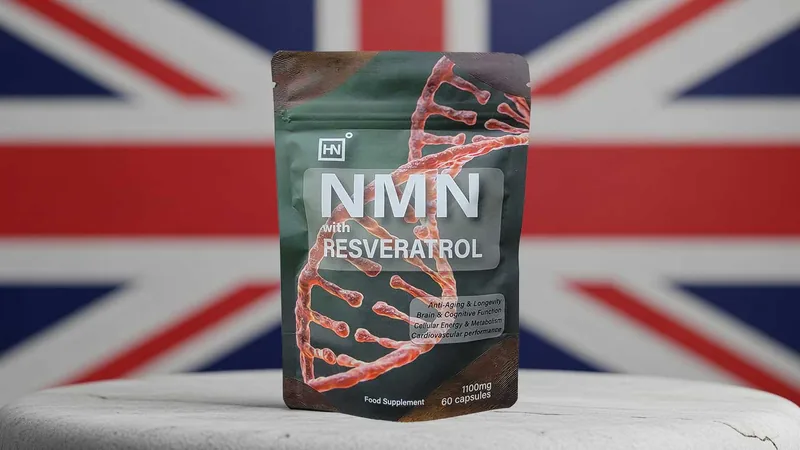
NMN has not completed that route. It sits under assessment, with products remaining available under transitional arrangements while applications progress. We have written about what that status does and does not mean in more detail.
Trans-resveratrol is a third case again: authorised, but with a hard ceiling of 150 mg a day for adults and a required warning for anyone on medication. We covered why the isomer on the label matters separately. You can see all three on our NMN + Resveratrol page.
Search the register before you accept a claim about legal status. It takes a minute and it is free.
Check the conditions of use, not just the entry. An authorisation can cap the daily amount, restrict the food categories, or require specific wording on the pack. Trans-resveratrol's 150 mg ceiling is a good example.
Treat "under assessment" as what it is: an application in a queue, not a verdict. It is neither an endorsement nor a warning.
And be sceptical of any brand that describes a pending application as approval. That distinction is the entire point of the register.
The picture may shift within two years. Following the May 2025 UK–EU summit, both sides agreed that a future sanitary and phytosanitary agreement would follow dynamic alignment with EU law, including regulated product authorisations.
The FSA told its March 2026 board that the government is aiming for implementation by mid-2027. It also said plainly that a substantial number of applications in the current system are unlikely to reach a ministerial decision before then.
The agency has written to applicants and adopted prioritisation principles. Businesses are being left to decide whether to keep pursuing a GB authorisation or switch focus to the EU route.
For anyone buying supplements, the practical effect is simple. The register is still the record that counts, and it will keep being the record that counts until an agreement is actually implemented. Check it there.
April 4, 2026

August 21, 2026