

April 4, 2026
August 21, 2026 · 7 min read

Seven of 20 resveratrol supplements assayed in a 2023 European survey named the isomer on the label. The other 13 just said "resveratrol".
That word covers two different molecules.
Trans-resveratrol carries its two phenol rings on opposite sides of the central double bond. Cis-resveratrol carries them on the same side. Identical formula, different shape.
Shape decides how a molecule sits in a binding pocket. Grapevines make the trans form. Nearly every human trial used the trans form. Almost everything written about resveratrol describes the trans form.
So the prefix is not decoration. It is the part of the name that tells you what you bought.
Trans-resveratrol is the stable isomer, and the only one anyone can supply as a defined ingredient at scale. It is also the form GB law recognises. Retained EU Decision 2016/1190 authorises trans-resveratrol in capsules and tablets for adults, up to 150 mg a day.
Cis-resveratrol has no such authorisation. It has also barely been given to humans.
The pharmacokinetics are humbling either way. Walle's tracer study gave six adults 25 mg of labelled resveratrol. At least 70% was absorbed. Peak plasma resveratrol plus metabolites reached 491 ng/ml. Unchanged resveratrol came in under 5 ng/ml.
The gut wall and liver conjugate it almost immediately. Absorption is not the problem. Survival is.
Boocock's dose-escalation study pushed harder. Forty healthy volunteers took single doses of 0.5, 1, 2.5 or 5 g, ten per level. Metabolite exposure ran up to 23 times higher than the parent compound.
Five grams is 33 times the legal daily supplement dose, and it still did not produce impressive levels of intact resveratrol.
Liu and colleagues pooled six randomised trials in 247 people. Resveratrol did not lower systolic or diastolic blood pressure overall. That is the headline, and it is a null one.
One subgroup moved. At 150 mg a day or more, systolic pressure fell 11.9 mmHg. The confidence interval ran from 2.8 to 21.0 mmHg, which is very wide for six small trials.
Glucose looks similar. Zhu's meta-analysis of nine trials in 283 people with type 2 diabetes found fasting glucose about 0.29 mmol/l lower, and fasting insulin 0.64 U/ml lower.
Small, real, and measured in people who already had a metabolic problem. None of it was measured in healthy 55-year-olds who lift four times a week.
Six randomised controlled trials, 247 participants. Resveratrol produced no significant change in blood pressure overall. Only the subgroup taking 150 mg a day or more showed a systolic reduction, and the estimate spanned 2.8 to 21.0 mmHg.
Source: Liu et al., Clinical Nutrition, 2015 (n=247 across 6 RCTs).
Here is where the trans-is-obviously-better argument gets awkward.
Both isomers bind human tyrosyl-tRNA synthetase, an enzyme that loads tyrosine onto transfer RNA. Sajish's group at South Carolina found the two forms lock it into different shapes.
Cis-resveratrol produced a conformation that promoted auto-PARylation of PARP1, a DNA-damage sensor. Trans-resveratrol produced the tyrosine-bound conformation, which inhibited it.
Their 2022 follow-up went further. In rat cortical neurons, cis-resveratrol supported serine-ADP-ribosylation-dependent DNA repair. Trans-resveratrol pushed the other way.
This is cell and rodent work from one laboratory. It is not a reason to buy cis-resveratrol, which nobody sells and nobody has tested in people. It is a reason to be sceptical of anyone claiming the isomer question is settled.
Cis-resveratrol bound tyrosyl-tRNA synthetase in a conformation that promoted PARP1 auto-PARylation and supported DNA repair in rat cortical neurons. Trans-resveratrol produced the opposite conformation and the opposite effect.
Source: Jhanji, Rao & Sajish, GeroScience, 2021; Jhanji et al., Nature Communications, 2022 (rodent neurons and cell assays).
The conversion is easy. Camont's group made cis-resveratrol by leaving a 100 µmol/l trans solution in sunlight for eight hours. No reagents, no catalyst. Just daylight.
Wine shows the same drift over longer timescales. Naiker tracked bottled red wine for 16 months. Trans-resveratrol fell 76%, with a mean bottle half-life of eight months.
Galician wines analysed by Feijoo averaged 12.68 mg/l trans-resveratrol in reds and 2.51 mg/l in whites. Cis levels sat at 0.06 to 0.12 mg/l. So the cis fraction in fresh wine is tiny — but it grows as the bottle ages.
Solid powder inside an opaque capsule is far more stable than resveratrol in solution. Still, the practical rule is dull and correct. Opaque container, cool cupboard, not the kitchen windowsill.
Bensa, Vovk and Glavnik assayed 20 resveratrol supplements sold in Europe. One product matched its declared content. One.
The rest ranged from 5% to 234% of the amount on the label. Two products held 5% of what they claimed. Eight held more than 150 mg per unit, above the authorised daily maximum.
Note what this means for the isomer question. If a manufacturer cannot get the total number right, the trans-to-cis ratio is not something they are tracking either.
Two routes dominate. Most cheap resveratrol is extracted from Japanese knotweed, Reynoutria japonica, which is unusually rich in it. The rest is made synthetically or by fermentation.
The authorisation route ran through the synthetic material. DSM applied to Ireland in 2012, and EFSA's panel assessed synthetic trans-resveratrol in December 2015. It concluded that 150 mg a day in adult supplements raised no safety concerns.
Extract and synthetic are not equivalent on purity. A knotweed extract brings whatever else the plant makes with it, including emodin, an anthraquinone with a laxative effect at high intakes. Bensa's survey logged what each label declared about origin, and the declarations varied widely.
Neither route is inherently better. But an extract needs a tighter specification to reach the same place, and a specification is exactly what the 13 unlabelled products in that survey were missing.
Five things worth checking, in order of how much they matter.
Does the label say "trans-resveratrol"? If it says only "resveratrol", the specification is undefined. That alone rules out a lot of products.
Is there a certificate of analysis? Ask for one naming trans-resveratrol content and the assay method. HPLC with UV detection is the standard. A seller who cannot produce it has not commissioned it.
Is the dose at or under 150 mg? GB law caps adult supplement intake at 150 mg a day. Anything higher is outside the authorisation, whatever the marketing says.
Is the packaging opaque? Clear capsules in a clear bottle on a shop shelf are a light-exposure problem you are paying for.
Does it carry the medication warning? The authorisation requires a statement that people taking medicines should only use the product under medical supervision. Resveratrol inhibits several cytochrome P450 enzymes, so this one is not box-ticking.
If a product fails the first two, the rest is academic. Read our complete guide to longevity supplements for how this compares across the category.
Trans is the right form to buy. Not because the molecule is proven superior in humans — that comparison has never been run — but because it is the form the trials used, the form the law authorises, and the form a manufacturer can actually specify.
The honest summary of the human evidence is modest. No blood pressure effect overall. A subgroup signal at 150 mg with wide error bars. A small glucose effect in people with type 2 diabetes. Bioavailability that makes any of it surprising.
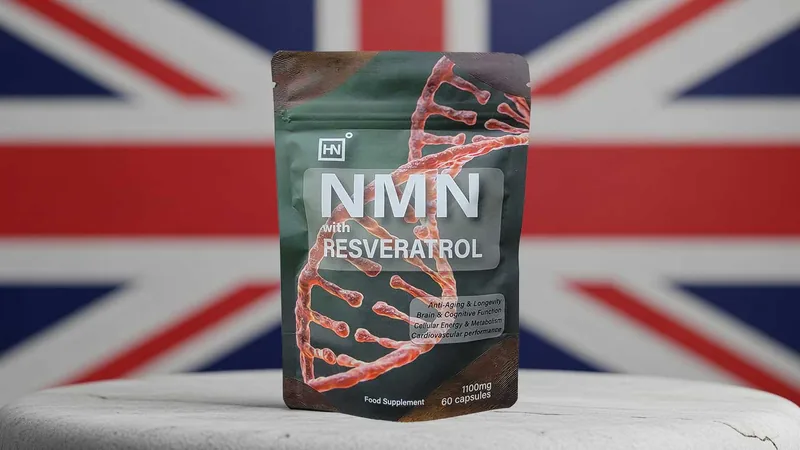
We include trans-resveratrol in our NMN + Resveratrol formula because the sirtuin rationale alongside an NAD+ precursor is coherent, and because 150 mg is a dose with human data behind it. We would rather you knew the effect sizes were small than found out later.
For how the two ingredients relate, read why the combination is put together this way. For the regulatory picture on the other half of the formula, see NMN's novel food status in the UK.
One number to keep. One product in 20 matched its own label. Buy from someone who publishes the assay.
April 4, 2026
April 4, 2026