
March 15, 2026
April 5, 2026 · 16 min read
The market for longevity supplements has exploded. With hundreds of products claiming to slow aging, reverse cellular decline, and add healthy years to your life, it is genuinely difficult to separate signal from noise. This guide cuts through the marketing and focuses on what the research actually says — which interventions have human trial evidence, which are promising but unproven, and which should be avoided or treated with caution.
The short answer: a relatively small number of supplements have meaningful human evidence for longevity-relevant outcomes. The three that consistently rise to the top are NMN (an NAD+ precursor), trans-resveratrol (a sirtuin activator), and DHA omega-3 (for membrane integrity and neuroinflammation). The rest of this guide explains why — and what the mechanisms behind each one tell us about aging itself.
Modern longevity science took a pivotal step forward in 2013 when Lopez-Otin and colleagues published their landmark paper in Cell identifying the hallmarks of aging — a framework for understanding the nine fundamental biological processes that drive cellular aging. Updated in 2023 in Nature with additional hallmarks, this framework has become the reference model for aging research worldwide.
The nine core hallmarks are: genomic instability (accumulating DNA damage), telomere attrition (shortening of the protective caps on chromosomes), epigenetic alterations (changes in gene expression patterns), loss of proteostasis (declining ability to clear misfolded proteins), deregulated nutrient sensing (dysfunction in pathways like mTOR, AMPK, and insulin signalling), mitochondrial dysfunction (declining energy production efficiency), cellular senescence (accumulation of non-dividing but metabolically active "zombie cells"), stem cell exhaustion (reduced regenerative capacity), and altered intercellular communication (including chronic low-grade inflammation, sometimes called inflammaging).
Supplements cannot address all of these hallmarks. No pill reverses telomere attrition or eliminates stem cell exhaustion. But three hallmarks — NAD+ decline (which cuts across mitochondrial dysfunction, genomic instability, and epigenetic alterations simultaneously), mitochondrial dysfunction, and altered intercellular communication (inflammation) — are areas where targeted dietary interventions have genuine human evidence. These are the mechanisms we will focus on.
To understand why NAD+ is central to longevity science, you need to understand what it does. NAD+ (nicotinamide adenine dinucleotide) is a coenzyme found in every cell in your body. It is essential for three overlapping systems that are each critical to healthy aging:
Energy production: NAD+ is a critical electron carrier in the mitochondrial electron transport chain. Without adequate NAD+, mitochondria cannot efficiently convert nutrients to ATP — the energy currency of the cell. This is why declining NAD+ is so directly linked to the fatigue and reduced physical performance that characterises aging.
DNA repair: PARP enzymes (poly-ADP ribose polymerases) are your cells' primary DNA repair machinery. These enzymes consume approximately 80% of available cellular NAD+ when DNA damage occurs. As we age, DNA damage accumulates faster — meaning PARP demand increases at the very time when NAD+ is declining. The result is a compounding deficit: less NAD+ available at the moment of greatest need.
Sirtuin activation: Sirtuins (SIRT1 through SIRT7) are a family of proteins that regulate gene expression, cellular stress responses, metabolic function, and inflammation. Every sirtuin is NAD+-dependent — they cannot function without it. SIRT1 and SIRT3, in particular, have been directly linked to longevity outcomes in multiple model organisms.
The problem is stark: NAD+ levels decline by approximately 50% between your 20s and your 60s. This single decline underpins multiple hallmarks simultaneously — mitochondrial dysfunction, impaired DNA repair, loss of epigenetic regulation, and inflammatory drift. For this reason, restoring NAD+ is widely considered the most evidence-backed dietary intervention currently available for longevity-relevant cellular function.
For a detailed primer on what NAD+ is and how it functions, see our guide: What is NAD+? And to understand how NMN fits into the picture, read: What is NMN?
NMN (nicotinamide mononucleotide) is a molecule your body naturally produces as part of the NAD+ biosynthesis pathway, and it is the most direct dietary precursor to NAD+. When taken as a supplement, NMN is absorbed in the gut and converted to NAD+ inside cells via the enzyme NMNAT (nicotinamide mononucleotide adenylyltransferase).
Two of the most important NMN human trials to date are Yoshino et al. (2021, published in Science) and Igarashi et al. (2022). The Yoshino study found that 250mg of NMN daily for 10 weeks in postmenopausal women improved muscle insulin sensitivity and gene expression in skeletal muscle consistent with NAD+ restoration. Igarashi and colleagues demonstrated that oral NMN supplementation significantly raised blood NAD+ levels and improved physical performance markers in older men. Multiple subsequent trials have confirmed safety at doses up to 1,200mg per day in humans.
NMN is preferred over the other main NAD+ precursor, NR (nicotinamide riboside), for a key biochemical reason: NMN enters the NAD+ biosynthesis pathway one step further downstream than NR. NR must first be converted to NMN before being converted to NAD+, meaning NMN requires one fewer metabolic step. This gives NMN a conversion efficiency advantage, particularly in tissues with limited metabolic capacity. (We discuss NR versus NMN in more detail in the "What the Research Doesn't Support" section below.)
The best dose based on current evidence is 500mg per day. This is the most commonly studied dose across human trials and represents the best balance of efficacy and value for most adults. For younger adults (under 35), 250mg may be sufficient. For those over 55 with a steeper NAD+ deficit, 750 to 1,000mg daily may be appropriate.
For a full breakdown of optimal NMN dosing by age and body weight, see our NMN dosage guide. For information on reported side effects and safety data, see our NMN side effects guide.
Resveratrol is a polyphenol found naturally in red grape skins, Japanese knotweed, and certain berries. It first attracted serious scientific interest when it was identified as a direct activator of SIRT1 — the sirtuin most closely associated with longevity outcomes. This discovery, made by David Sinclair and colleagues at Harvard, triggered an enormous wave of research into sirtuins as longevity targets.
The critical mechanistic point is this: sirtuins are NAD+-dependent. Without sufficient NAD+, resveratrol cannot activate SIRT1 efficiently — there simply isn't enough substrate for the enzyme to work. This is precisely why combining NMN with resveratrol makes biochemical sense. NMN raises NAD+ levels, providing the raw material; resveratrol activates the sirtuins that use that NAD+ to carry out cellular repair, DNA maintenance, and metabolic regulation. Research suggests the combination produces synergistic outcomes greater than either supplement alone.
There is one crucial distinction when buying resveratrol: trans-resveratrol is the biologically active isomer. Cis-resveratrol, found in many cheaper formulations, has negligible sirtuin-activating activity. Always check that any resveratrol supplement specifies the trans form, and that purity is verified by third-party testing.
Studied doses of trans-resveratrol span roughly 100mg to 1,000mg per day, and the limiting factor is absorption rather than the number on the label. Resveratrol is taken up efficiently in the gut but then conjugated so rapidly by first-pass metabolism that only a small fraction circulates as the free active compound — which is why dose alone is a poor guide to what actually reaches your tissues. Two things meaningfully improve that: pairing it with piperine (BioPerine®), which inhibits the glucuronidation pathway doing the clearing, and taking it with dietary fat such as avocado, nuts, eggs, or olive oil, since resveratrol is fat-soluble. This is another reason to take it with food rather than on an empty stomach.
For a full discussion of why NMN and resveratrol work better together than either does alone, including the synergy data, see our guide: NMN + Resveratrol combination.
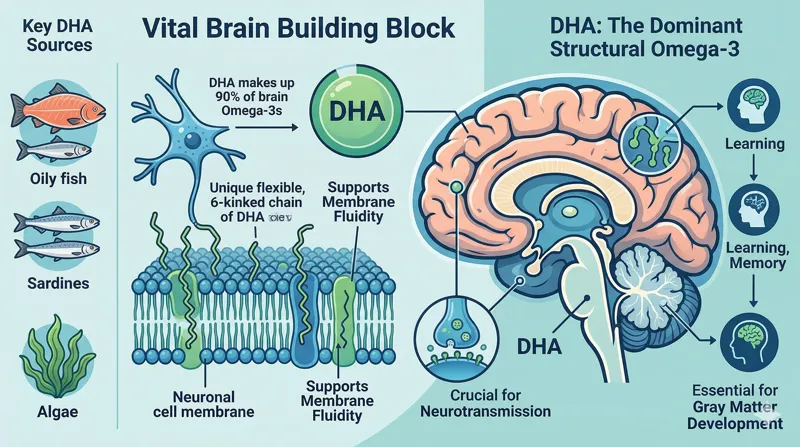
DHA (docosahexaenoic acid) is a long-chain omega-3 fatty acid and the dominant structural component of grey matter in the human brain — comprising approximately 97% of all omega-3 fatty acids in brain tissue. It is not merely a nutritional supplement; it is literally a structural building block of your neurons.
As we age, cellular membranes — including neuronal membranes — gradually lose fluidity. This membrane stiffening impairs signalling between cells, affects receptor function, and contributes to cognitive decline. DHA supplementation helps maintain membrane fluidity by keeping phospholipid bilayers supple and permeable. This is especially important in the brain, where signal transmission depends on the physical properties of the cell membrane.
The most cited human trial evidence for DHA and cognition is Yurko-Mauro et al. (2010), which found that 900mg per day of DHA for 24 weeks significantly improved memory and learning in older adults with age-related cognitive decline, compared to placebo. This was a double-blind, randomised controlled trial — the gold standard of clinical evidence.
Beyond membrane integrity, DHA has a second important longevity-relevant mechanism: it serves as the precursor to a class of signalling molecules called resolvins and protectins. These molecules actively resolve inflammatory signalling — they don't just suppress inflammation (as ibuprofen does), they promote the resolution of existing inflammatory cascades. Chronic low-grade inflammation, or inflammaging, is one of the most consistent biomarkers of biological aging, and DHA's role in counteracting it gives it dual relevance as a longevity supplement.
For sourcing, algae-derived DHA is worth choosing over fish oil for several reasons. Algae is the original biosynthetic source of DHA — fish accumulate DHA by eating algae. Algae-derived DHA is therefore free from the marine contaminants (heavy metals, PCBs, dioxins) that can concentrate in fish-based oils. It is also vegan and more sustainable. Research confirms the bioavailability is equivalent to fish-derived DHA.
For more on DHA and brain health, see: DHA and brain health. For a guide specifically for UK consumers considering plant-based omega-3, see: vegan omega-3 guide. And if brain fog is your primary concern: omega-3 for brain fog.
Honest assessment of the evidence is what separates genuinely useful health information from marketing copy. The following supplements are frequently discussed in longevity circles — here is a clear-eyed summary of where the evidence actually stands for each.
Berberine: Berberine is an alkaloid found in several plants and acts as an AMPK activator — similar in mechanism to metformin. Animal data and some short-term human metabolic studies are genuinely interesting, particularly for blood sugar regulation and lipid profiles. However, there is currently no long-term human longevity trial data. Berberine is promising but unproven for longevity specifically, and its bioavailability is notoriously poor without formulation interventions.
Rapamycin: Rapamycin (sirolimus) has the strongest longevity data of any pharmacological intervention in animal models — it extends lifespan in mice even when started in middle age, which is remarkable. The mechanistic rationale (mTOR inhibition) is scientifically compelling. However, rapamycin is a prescription immunosuppressant used in organ transplant medicine. Self-prescribing it for longevity purposes carries serious risks including infection susceptibility, impaired wound healing, and metabolic disruption. This is not a supplement to take without close medical supervision, and we would not recommend it as a self-directed intervention.
Metformin as a longevity supplement: Metformin is a prescription diabetes drug with genuine interest from the longevity research community — the TAME (Targeting Aging with Metformin) trial, a large-scale human longevity trial, is currently ongoing. However, metformin is not available over-the-counter, and its use outside of type-2 diabetes management requires a prescription and medical monitoring. It is also worth noting that some research suggests high-dose metformin may attenuate the mitochondrial adaptations to exercise.
High-dose antioxidants (vitamin E and C in large doses): The antioxidant theory of aging — the idea that neutralising free radicals slows cellular aging — underpinned decades of supplement marketing. The clinical evidence has not supported it. Multiple large randomised controlled trials have found that high-dose vitamin E and C supplementation does not extend life and in some populations may cause harm. The SELECT trial found that high-dose vitamin E increased prostate cancer risk. The CARET trial found that beta-carotene supplementation increased lung cancer risk in smokers. Antioxidants from whole foods appear beneficial; megadose supplementation does not.
NR vs NMN: Both nicotinamide riboside (NR) and nicotinamide mononucleotide (NMN) raise blood NAD+ levels in humans, and both have clinical evidence. NR is one metabolic step further from NAD+ than NMN — it must first be phosphorylated to NMN before being converted to NAD+. This gives NMN a modest conversion efficiency advantage, and NMN has attracted more recent human trial investment. The practical difference at typical supplementation doses may be modest, but the advantage leans toward NMN on current evidence.
Based on the evidence reviewed above, our recommended longevity supplement protocol uses two products targeting the three most modifiable cellular mechanisms of aging.
Mechanism: NAD+ restoration (NMN) + sirtuin activation (trans-resveratrol). These two pathways are interdependent — NMN provides the substrate that resveratrol's target enzymes require to function.
Dose: 500mg NMN + 600mg 98% trans-resveratrol per two-capsule serving. Also contains 10mg BioPerine (black pepper extract) to enhance absorption.
When to take: Morning with food, ideally containing some healthy fats to support resveratrol absorption.
Shop NMN + Resveratrol →Mechanism: Cellular membrane integrity (neuronal and cardiovascular), anti-neuroinflammation via resolvin and protectin pathways. Addresses the inflammaging hallmark of aging.
Dose: 500mg DHA per two-softgel serving. Sourced from algae — the original biosynthetic source of DHA, free from marine contaminants.
When to take: With the same morning meal as your NMN + Resveratrol. DHA is fat-soluble and absorbs better with food.
Shop Omega-3 DHA →Together, this stack addresses NAD+ decline, sirtuin pathway underactivation, mitochondrial inefficiency, chronic neuroinflammation, and cellular membrane degradation — five of the most modifiable mechanisms across the hallmarks of aging framework.
Supplements are not a substitute for lifestyle. They are interventions that work best when layered onto a baseline of habits that support the same cellular pathways. Here are the four lifestyle factors with the strongest mechanistic synergy with the longevity supplement stack described above.
Caloric restriction or time-restricted eating: Reducing caloric intake, even modestly, activates AMPK and suppresses mTOR — two of the key nutrient-sensing pathways implicated in longevity. Time-restricted eating (eating within an 8 to 10-hour window) achieves similar effects with less psychological burden. Both interventions are synergistic with sirtuin activation: fasting upregulates SIRT1 activity through AMPK-mediated NAD+ elevation, which means resveratrol's sirtuin-activating effects are amplified in a fasted or restricted-eating context.
Resistance training: Skeletal muscle is one of the most metabolically active tissues in the body and one of the highest consumers of NAD+ during exercise. Resistance training increases demand on the NAD+/sirtuin system in muscle — which means NMN supplementation may be particularly valuable for those who train regularly, both to support the energy demands of training and to facilitate the DNA repair and cellular regeneration that occurs during recovery. Several NMN trials used exercise performance as a primary outcome measure precisely because of this connection.
Quality sleep: NAD+ is partially regenerated during sleep through NAMPT (nicotinamide phosphoribosyltransferase), the rate-limiting enzyme in the NAD+ salvage pathway. NAMPT expression follows a circadian rhythm, with peak activity during sleep. Chronic sleep disruption not only impairs this regeneration but also increases PARP activation (from oxidative stress), accelerating NAD+ depletion. Seven to nine hours of consistent sleep is genuinely one of the most powerful longevity behaviours — not for motivational reasons, but for specific biochemical ones that directly interact with the NAD+ pathway.
Avoiding excess alcohol: Alcohol metabolism competes directly with NAD+. The enzyme ALDH2 (aldehyde dehydrogenase 2), which metabolises acetaldehyde (the toxic breakdown product of alcohol), is heavily NAD+-dependent. Chronic alcohol consumption depletes NAD+ significantly — undermining the very pathway that NMN supplementation is designed to support. Moderate alcohol consumption (one to two units occasionally) is unlikely to cause meaningful NAD+ depletion, but regular or heavy drinking will meaningfully blunt the efficacy of any NAD+ precursor supplementation.
The strongest human trial evidence exists for NAD+ precursors (primarily NMN), omega-3 DHA, and trans-resveratrol. These three address the most well-documented and modifiable mechanisms of cellular aging: NAD+ decline, mitochondrial dysfunction, chronic inflammation, and membrane degradation. Most other marketed longevity supplements either lack human data or have only been tested in animal models. Vitamin D and magnesium also have general health evidence but are not specifically longevity-targeted interventions in the same way.
Yes, based on current evidence. Multiple human clinical trials — including Yoshino et al. (2021, Science) and Igarashi et al. (2022) — have demonstrated that NMN supplementation safely raises blood NAD+ levels and improves biomarkers of metabolic health. NAD+ declines roughly 50% between your 20s and 60s, and this decline is linked to multiple hallmarks of aging. Restoring NAD+ via NMN is one of the most evidence-backed dietary interventions currently available, and the safety profile across all human trials to date has been excellent.
The best-evidenced longevity stack based on current human trial data is: 500mg NMN + 600mg trans-resveratrol taken in the morning with food, plus 500mg DHA omega-3 (algae-sourced) taken with the same meal. This combination addresses NAD+ decline, sirtuin pathway activation, and neuroinflammation — three of the most modifiable hallmarks of aging with the strongest dietary intervention evidence. The three compounds work synergistically: NMN provides NAD+ substrate, resveratrol activates sirtuin enzymes that use that NAD+, and DHA supports the cellular membrane environment within which all of these signalling processes occur.
It depends on what you are measuring. Blood NAD+ levels typically rise measurably within 2 to 4 weeks of NMN supplementation. Subjective improvements in energy and mental clarity are often reported within the first month. More structural changes — improved metabolic markers, cognitive performance, exercise recovery — tend to appear after 2 to 3 months of consistent use. The deeper longevity benefits, by definition, accumulate over years rather than weeks. The most important factor is long-term consistency rather than expecting rapid transformation. Think of these supplements the way you would think about exercise: the daily habit is more important than any individual session.
This guide is for informational purposes and does not constitute medical advice. Always consult your healthcare provider before starting any new supplement, particularly if you are pregnant, nursing, take prescription medications, or have underlying health conditions.
March 15, 2026
April 4, 2026