
August 27, 2026
August 30, 2026 · 8 min read

Take 250 mg of NMN after 6pm for twelve weeks and your sleep score falls 1.5 points. Take a placebo after 6pm and it falls 1.6.
That comparison comes from the only randomised trial designed to test NMN timing. Kim and colleagues split 108 Japanese adults aged 65 and over into four arms. NMN before noon. NMN after 18:00. Matching placebos at each hour.
The design is the good part. Two active arms tell you whether the hour matters. Two placebo arms tell you whether the hour matters at all, drug or no drug. Most timing studies skip the second half.
Compliance ran above 95% in every group. Three people dropped out of 108. For a twelve-week supplement trial in over-65s, that is unusually clean execution.
The headline that travelled was that evening won. It did, on one reading. It also did not, on the reading that counts.
Evening NMN posted the largest within-group effect sizes in the trial. Five-times sit-to-stand improved with d = 0.72. Drowsiness improved with d = 0.64. Morning NMN managed d = 0.40 and d = 0.08 on the same two measures.
Those are real gaps. Sit-to-stand time predicts falls and independence better than grip strength does, so an effect that size in a 65-plus group would be worth having.
Now look sideways. Morning placebo improved sit-to-stand with d = 0.41 — marginally more than morning NMN. Evening placebo improved drowsiness with d = 0.50. It also fell further on the total PSQI sleep score than any other arm: 1.6 points, against 1.5 for evening NMN.
The between-group interaction for sleep quality was not statistically significant. The authors say so themselves, and flag a probable placebo effect. Sleep was measured by questionnaire, not by actigraphy or polysomnography.
So the honest summary of the timing literature is one trial, in which evening dosing helped and the evening pill did not need to be NMN.
108 adults aged 65 and over took 250 mg of NMN or placebo, either before noon or after 18:00, for 12 weeks. Evening NMN produced the largest within-group effect sizes for sit-to-stand (d = 0.72) and drowsiness (d = 0.64). The evening placebo arm improved on drowsiness and on total sleep score too, and the group-by-time interaction for sleep quality was not significant.
Source: Kim et al., Nutrients, 2022 (n=108).
The definitions were loose, and that matters if you plan to copy the protocol.
"Morning" meant any time from waking until 12:00. "Evening" meant any time from 18:00 until bed. Across roughly 27 people per arm, over 84 days, that is a wide spread of actual clock times.
Nobody measured when participants ate, trained or went to bed relative to the capsule. So the trial tested two broad windows, not two doses at fixed hours.
If you want to reproduce the evening condition, the defensible version is: after your evening meal, before you start winding down. That is the middle of the window they used.
One more design note worth holding onto. Everyone in the trial was 65 or over, Japanese, community-dwelling, and screened out if they took sleeping medication or drank more than 400 mg of caffeine a day. A fit 52-year-old who trains five times a week is not that population. Nothing here transfers automatically.
Irie and colleagues gave ten healthy men a single 100, 250 or 500 mg dose at 9am after an overnight fast, then followed them for five hours. Three nicotinamide metabolites appeared in plasma. Two of them, 2-PY and 4-PY, rose in step with the dose.
The whole event fits inside a working morning. Oral NMN is not a depot. It is absorbed, converted and cleared over hours.
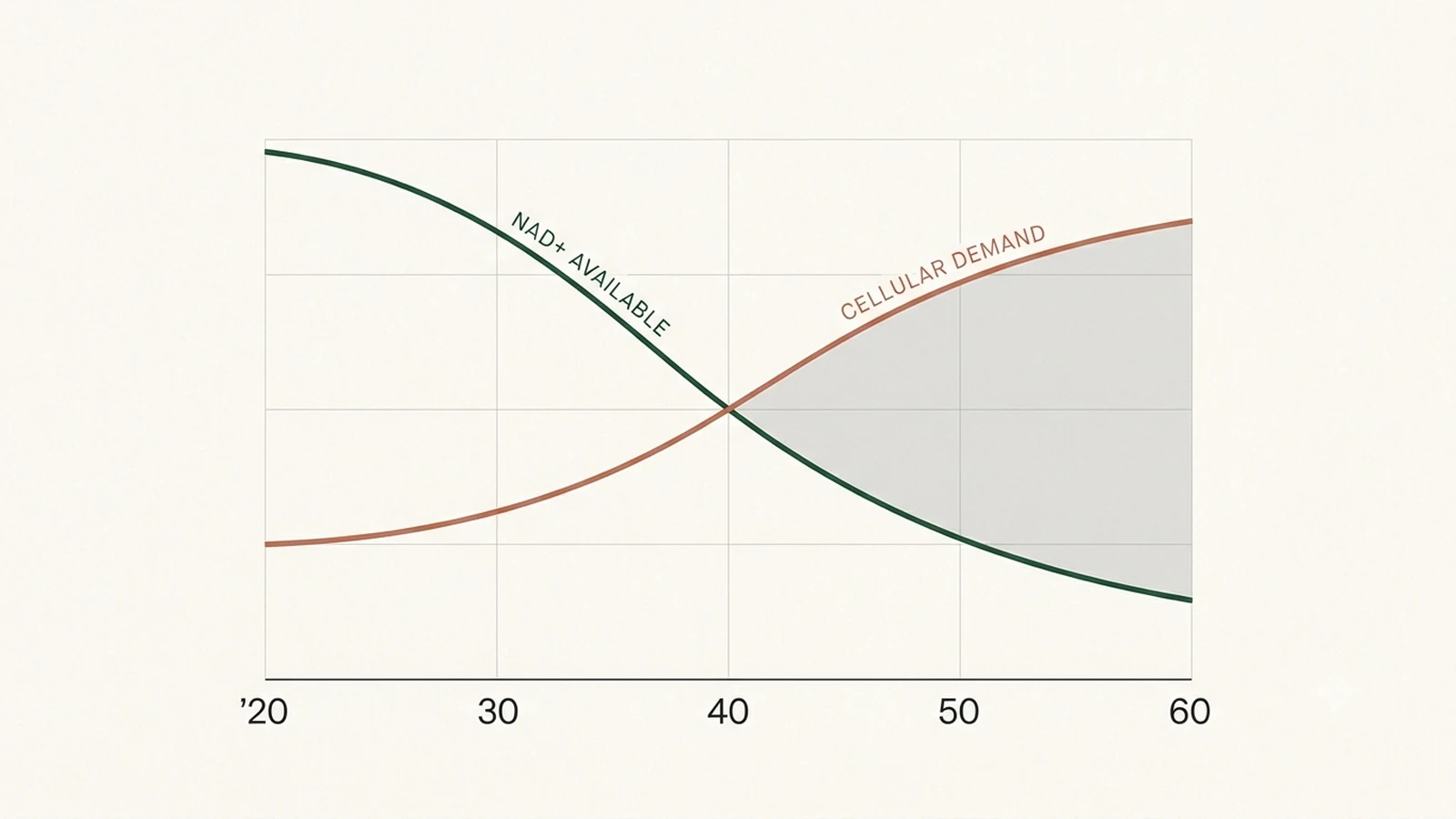
The NAD+ pool it feeds moves on a slower schedule. So daily dosing is really a question of steady state, not of hitting a window. Under that model, the hour you choose changes the shape of one small daily peak against a much flatter background.
There is a second reason the hour is unlikely to be decisive. A good deal of oral NMN ends up as nicotinamide, which is one of the two forms of niacin found in ordinary food. The NHS notes that nicotinamide supplements at 500 mg a day or less are unlikely to cause harm. You are nudging a familiar nutrient pathway, not dosing a chronotherapeutic drug.
This also disposes of the split-dose question. Halving a daily amount across morning and evening would smooth that small peak into two smaller ones. No human trial has tested whether that changes any outcome. Every trial cited on this page used a single daily dose, so single dosing is the option with evidence behind it, however weak. If you want the background on the molecule itself, what NAD+ actually does covers it.
The mechanism people cite for evening dosing is real, up to a point. Benedict and colleagues sampled serum NAMPT every 1.5 to 3 hours across 24 hours in 14 healthy men. NAMPT is the rate-limiting enzyme of the NAD+ salvage pathway.
They found a pronounced diurnal rhythm, peaking in the early afternoon and running inverse to leptin. Keeping the men awake for a full 24 hours preserved the rhythm but advanced it by about two hours. The size of each man's phase shift tracked his rise in two-hour postprandial glucose (r = 0.54).
That is a genuine human clock signal, and it peaks in the afternoon — not the evening, and not at 7am.
The pool itself is another matter. Cuenoud and colleagues used 7-tesla phosphorus spectroscopy to measure occipital brain NAD in 25 healthy men, at 8-9am and again at 3-4pm. Salivary cortisol confirmed the two sessions caught genuinely different physiological states.
Brain NAD did not differ significantly between them. Neither did the NAD+/NADH ratio, which drifted 5.9% and missed significance. The participants were all in their twenties, and only one brain region was scanned, so this does not disprove a human NAD+ rhythm.
What it does mean is that anyone telling you your NAD+ "bottoms out at night" is extrapolating from mouse liver. Treat that as a hypothesis with a marketing budget.
Yi and colleagues randomised 80 healthy middle-aged adults to placebo, 300, 600 or 900 mg of NMN daily for 60 days. Blood NAD rose significantly at every active dose by day 30 and day 60.
Six-minute walk distance improved more than placebo at all three doses. The 600 mg and 900 mg groups did better than 300 mg on both NAD and walking distance, and the authors put peak efficacy at 600 mg.
Yoshino and colleagues ran 250 mg for ten weeks in 25 postmenopausal women with prediabetes. Muscle insulin sensitivity, measured with a hyperinsulinaemic-euglycaemic clamp — the reference method, not a blood-sugar proxy — rose about 25%. Body weight and composition did not change.
Then the deflating part, which belongs here rather than buried. Hui and colleagues pooled eight randomised trials covering 342 adults, at 250 to 2,000 mg a day, for 14 days to 12 weeks. There was no significant pooled benefit on fasting glucose, fasting insulin, HbA1c, HOMA-IR or lipids.
That is our own category, and it is a thin base. Anyone arguing about the hour is arguing several rungs above where the evidence actually sits. Our NMN dosage guide covers the amount question in full.
Take it in the evening if you like. One trial points that way, the effect was not significant against its own placebo, and moving a capsule three hours costs nothing.
Take it at the same time every day. Kim's trial got above 95% compliance and still produced modest results. Your own consistency is the variable most likely to differ from theirs, and it is the one you control.
Judge it over eight to twelve weeks. Every trial above ran for at least ten. Nothing in this literature resolves in a fortnight.
Fix the dose before you fix the hour. Kim used 250 mg. Yi found 600 mg optimal. Our own NMN + Resveratrol carries 500 mg. That range spans a real difference in blood NAD; morning versus evening does not span a proven difference in anything.
Check the certificate of analysis while you are at it. Label accuracy is a solved problem for any brand willing to publish batch testing, and it is worth more than an hour on the clock. A capsule containing less NMN than it claims fails at every dosing time equally.
And if you are chasing NMN timing because your sleep has been poor for months, the clock itself is the bigger lever. Wake time, morning light and last meal timing all have stronger human evidence behind them than any capsule schedule — our piece on sleep, NAD+ and circadian rhythm goes through them. Sleeping badly for three months or more is a GP conversation, not a supplement one.
The single most useful sentence in the timing literature is still the one nobody quotes: the evening placebo group did just as well.
August 27, 2026
April 4, 2026