

July 25, 2026
August 28, 2026 · 7 min read
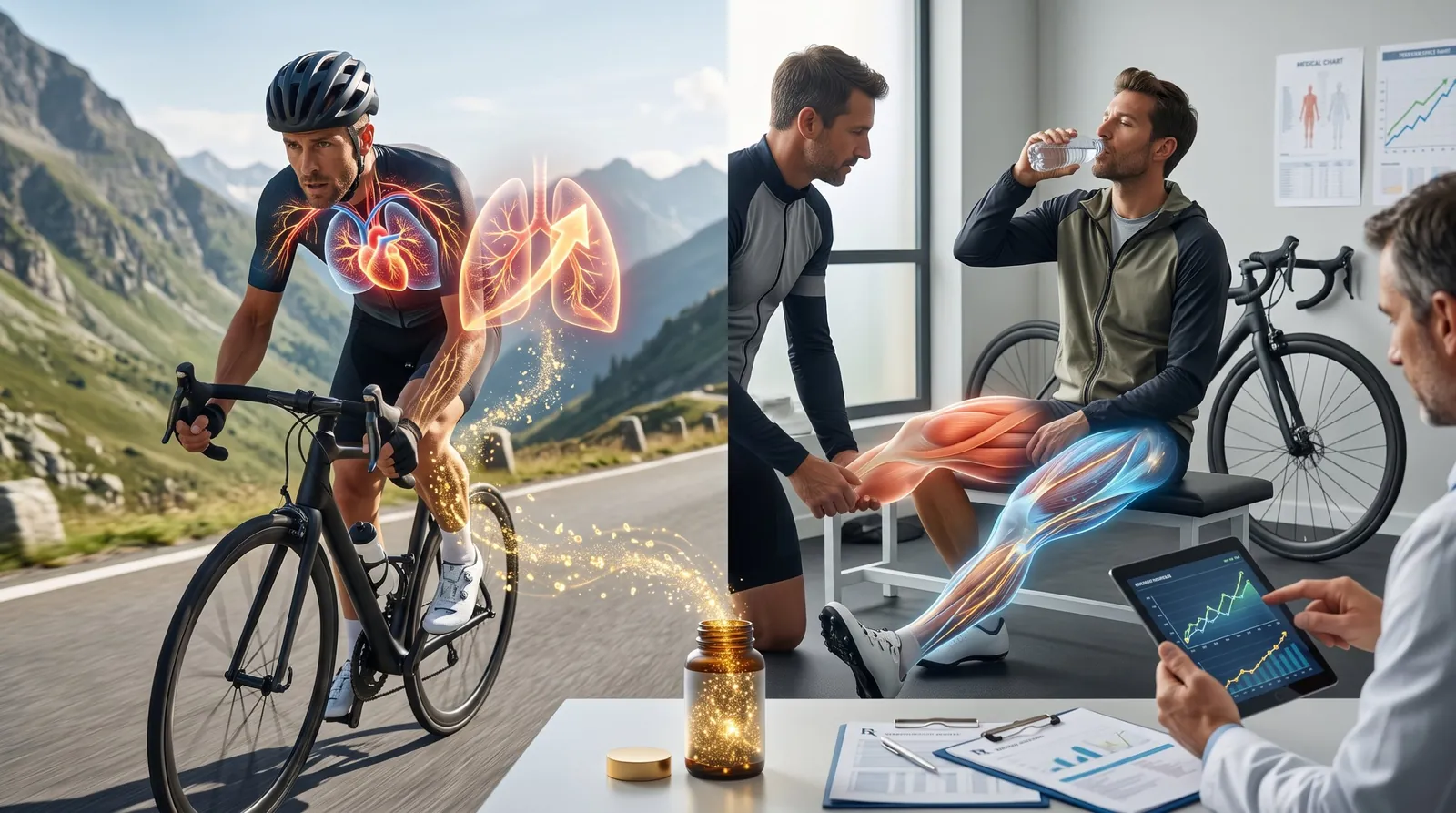
Forty-eight amateur runners took NMN for six weeks. The doses were 300, 600 and 1,200 mg a day, against a placebo arm. Everyone trained five or six times a week throughout.
VO2 max did not move. Neither did peak power, O2 pulse, nor maximum heart rate. That is the headline the adverts skip.
What did shift was the ventilatory threshold. Oxygen uptake at the first threshold rose. So did the power the runners could hold at both thresholds. The effect grew with the dose.
One trial. One running club in Guangzhou. No second group has repeated it. Hold that in mind for everything below.
NMN raised oxygen uptake and power at the ventilatory thresholds, and the effect tracked the dose upward. VO2 max, peak power and O2 pulse were unchanged in every arm. No adverse events were reported.
Source: Liao et al., Journal of the International Society of Sports Nutrition, 2021 (n=48).
VO2 max is your ceiling. Your threshold is the share of that ceiling you can sit at for an hour. Cyclists buy the second one far more often than the first.
Two riders with the same VO2 max can be minutes apart up the same climb. The gap is threshold. Threshold is mostly muscle: capillary density, mitochondria, lactate handling. The heart sets the ceiling. The legs decide how much of it you get to use.
That matters because of where the runners' trial found its signal. The authors argued the change looked muscular rather than cardiac, precisely because VO2 max and O2 pulse stayed flat. If NMN does anything for endurance, it does it downstream of the heart.
Which is the good news and the catch in one line. Muscle is the exact tissue your training already works on.
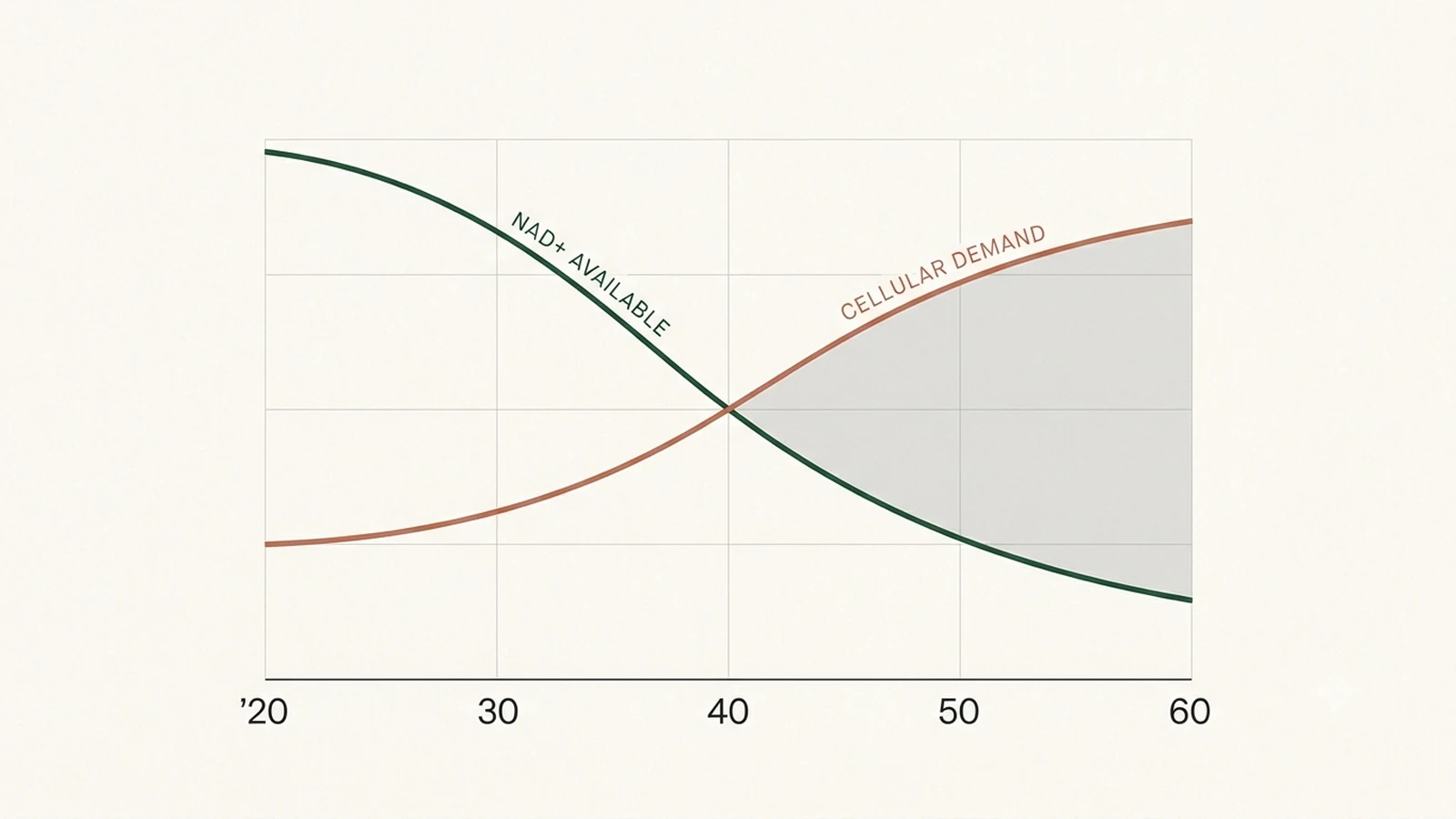
NAD+ is recycled far more than it is built from scratch. The rate-limiting enzyme in that salvage loop is NAMPT. NAMPT falls with age, and that fall is a large part of why NAD+ drops across a lifetime.
Twelve weeks of training raised it. In adults over 55, aerobic training lifted muscle NAMPT by 28%. Resistance training lifted it by 30%. In under-35s the same programmes gave 12% and 25%.
Across the whole group, VO2 peak was the single best predictor of how much NAMPT someone carried.
Read that predictor line twice. The fittest people carried the most NAD+ salvage capacity, with no capsule involved. If you ride four or five times a week, you already run the intervention with the strongest evidence behind it.
None of this says a supplement adds nothing on top. It says the supplement is arguing over the margin, not the main effect.
Twelve weeks of aerobic or resistance training raised skeletal muscle NAMPT in young and older adults alike, with the larger gains in the over-55s. VO2 peak was the best predictor of NAMPT levels across the sample.
Source: de Guia et al., Physiological Reports, 2019.
Recovery is where NAD+ products are sold hardest and tested least.
The most direct test used nicotinamide riboside with pterostilbene, in 32 adults aged 55 to 80. Researchers injured a muscle deliberately, then tracked how it repaired. Muscle stem cell recruitment, fibre area, central nuclei, embryonic myosin — none of it differed from placebo.
The supplement was safe. It did nothing measurable to repair.
A second trial gave twelve older men 1 g of nicotinamide riboside daily for 21 days. Muscle NAD+ metabolites rose. Mitochondrial bioenergetics did not change. A third study, a week long, found no effect on muscle metabolism at rest or during exercise.
Nicotinamide riboside is a different molecule to NMN, and that is a fair objection. But it is the closest human evidence on muscle repair that exists, and it is null three times over. Nobody has run the equivalent trial on riders after a hard block.
32 adults aged 55 to 80 took 1,000 mg nicotinamide riboside plus 200 mg pterostilbene daily around an experimental muscle injury. Stem cell recruitment and every histological marker of regeneration matched placebo.
Source: Jensen et al., JCI Insight, 2022 (n=32).
A 2024 systematic review pooled ten randomised trials and 437 participants. Mean age 58, mean follow-up 9.6 weeks, doses from 150 to 1,200 mg a day.
Mean grip strength went from 29.9 kg to 30.5 kg. The reviewers described the physical performance changes as non-significant.
Six hundred grams of grip. That is the size of the effect across the whole literature.
Individual trials are more mixed. A 12-week trial of 250 mg a day in older Japanese men reported better gait speed and left-hand grip strength, though only 20 of the 42 randomised finished it. A 60-person trial at the same dose missed its primary endpoint, a stepping test, but reported a shorter 4-metre walk time and better sleep quality scores as secondary outcomes.
Older, largely untrained people. Walking tests and hand dynamometers. None of it is a bike, and none of it is a trained 55-year-old.
Eight randomised trials. 342 middle-aged and older adults. Doses of 250 to 2,000 mg a day, for two weeks to twelve.
Pooled, NMN did nothing to fasting glucose, fasting insulin, HbA1c, HOMA-IR or blood lipids. Not a small effect. No effect.
One trial stands apart. Twenty-five postmenopausal women with prediabetes took 250 mg for ten weeks. Insulin-stimulated glucose disposal, measured with a clamp, rose against placebo, as did muscle insulin signalling.
Twenty-five people, one outcome, one population. It is the most-cited NMN result in the field and it has not been replicated.
You have something runners do not. A power meter turns a vague feeling into a number, so use it properly.
Pick one repeatable test. A 20-minute effort or a ramp, same route or same trainer, same time of day, same fuelling, same tyres. Run it twice before you start anything. That gives you your own noise floor.
Most riders swing 3 to 5% week to week for reasons that have nothing to do with capsules. A change smaller than your own swing tells you nothing.
Give it eight to twelve weeks. Six weeks was enough in the runners' trial, but that used lab gas analysis, and your test is cruder.
Track threshold power, not peak power. That is where the one relevant trial found its signal. Sprint numbers stayed flat, so testing your five-second peak tests the wrong thing.
Doses across the trials ran from 250 mg to 1,200 mg a day. Most sat between 250 and 600. The runners' dose-response pointed upward, but the wider literature does not show more being reliably better, so there is no case for starting high. Our dosage guide goes through the trade-offs.
And change one thing at a time. Adding NMN in the same month you add two hours a week is not a test. It is a story you will tell yourself.
The whole case for NMN and cycling performance is one six-week trial in 48 runners. It moved threshold and left VO2 max alone. Everything else is older, untrained cohorts walking four metres down a corridor.
Ranked by evidence per pound, your training block wins. Then sleep. Then protein. Then iron and vitamin D if your bloods say so. NMN sits below all of that.
If you ride five hours a week and sleep six hours a night, fix the sleep. That is not a hedge. It is the ordering the evidence supports.
If those are already handled and you want to run the experiment anyway, the trials to date reported no serious adverse events, and the cost is modest. Measure it against your own numbers over a full training block. Then be willing to read a flat result as flat.
That is the honest position on our own category, and we would rather you had it before you bought anything.
July 25, 2026
August 27, 2026