
August 28, 2026
September 8, 2026 · 8 min read
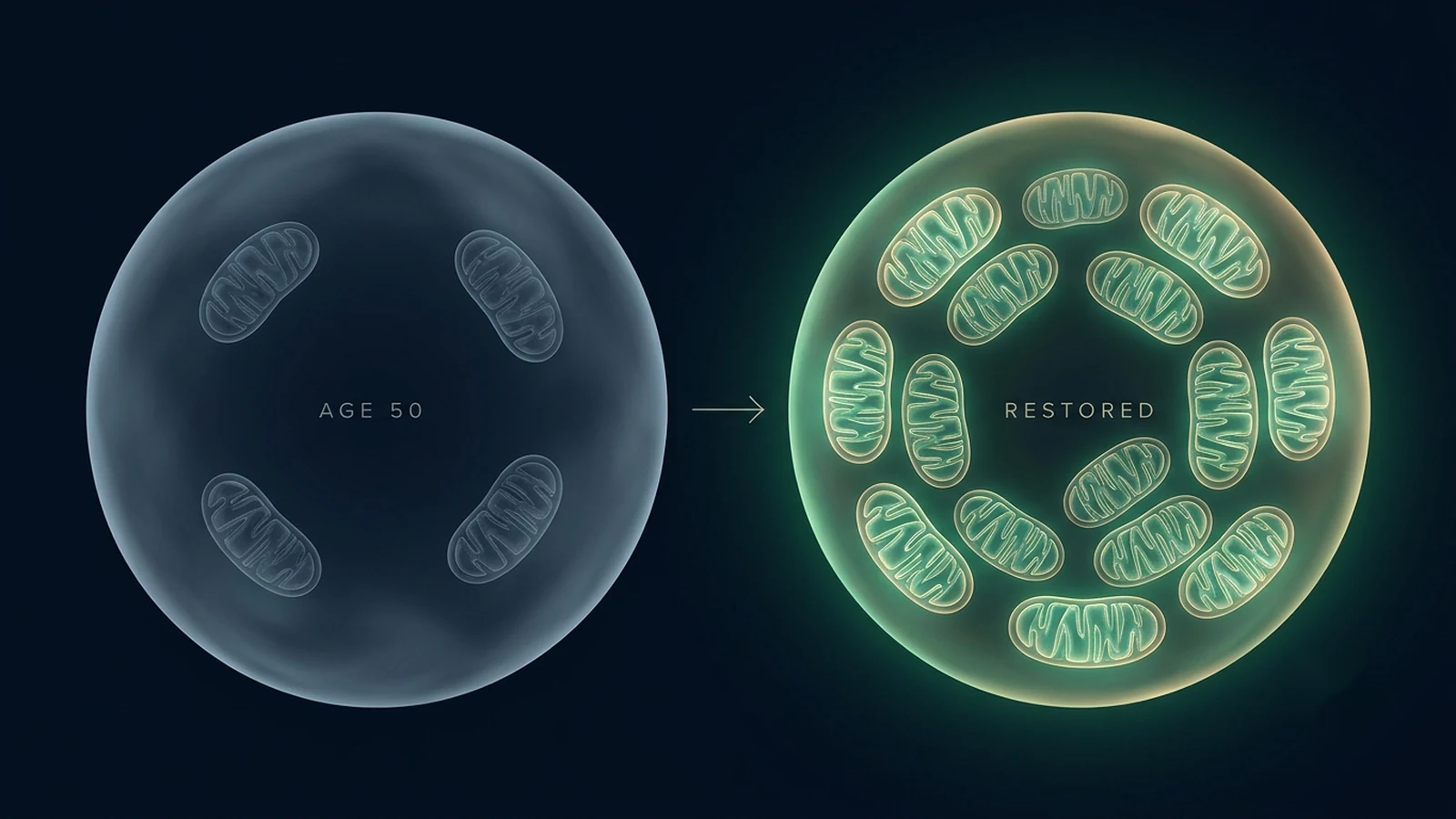
CoQ10 carries electrons between complexes I, II and III of the electron transport chain. It is the shuttle. NAD+, which NMN feeds, is what delivers electrons into complex I in the first place. It is the delivery van.
So the question is not which one makes more energy. Both are needed, and a healthy cell runs out of neither. The question is which one, taken as a capsule, changes anything measurable in a person who is not deficient.
On that question the two have very different answers. One has a modest but repeatable effect. The other has a much thinner file.
Thirteen randomised trials, 1,126 participants, pooled in 2022. Fatigue scores fell against placebo by Hedges' g = -0.398, with a 95% confidence interval of -0.641 to -0.155.
That is a small-to-moderate effect. In plain terms, roughly a third of a standard deviation on a fatigue questionnaire. Not nothing, and not the transformation the packaging implies.
Two details matter more than the headline. The direction was the same in healthy participants and in patients, which argues against it being a sick-people-only finding. And the effect was significant when CoQ10 was given alone, but not when it was buried inside a multi-ingredient compound.
If you buy a blend where CoQ10 is one of nine things on the label, you are buying the arm of the analysis that did not work.
Thirteen randomised controlled trials in 1,126 adults. CoQ10 reduced fatigue scores compared with placebo (Hedges' g = -0.398, 95% CI -0.641 to -0.155, p = 0.001). Higher daily doses and longer treatment were each associated with larger reductions. One gastrointestinal adverse event was reported across 602 people taking CoQ10.
Source: Tsai et al., Frontiers in Pharmacology, 2022 (n=1,126 across 13 RCTs).
For someone training four or five times a week, fatigue questionnaires are the wrong outcome. Blood markers after hard sessions are closer to the point.
A 2024 dose-response meta-analysis pooled 28 trials in 830 adults. Creatine kinase fell by 50.6 IU/L against placebo. Lactate dehydrogenase fell by 52.1 IU/L. Myoglobin fell by 21.8 ng/ml. Malondialdehyde, a lipid oxidation marker, fell by 0.73 micromol/l.
There was a gradient. Each additional 100 mg a day was associated with a further 23.1 IU/L fall in creatine kinase.
Two caveats, both real. Most of these trials were run in Asia, which the authors flag as a limit on generalisability. And lower creatine kinase is a marker of less muscle disruption, not proof you will recover faster or train better. Nobody has shown the second thing follows from the first.
Ten randomised trials, 437 participants, mean age 58, average follow-up 9.6 weeks, doses from 150 to 1,200 mg a day. Mean grip strength went from 29.9 kg to 30.5 kg. Skeletal mass index went from 7.4 kg/m2 to 7.4 kg/m2.
The review's own conclusion was that physical performance improved non-significantly. That is an honest way of saying it did not improve.
The metabolic picture is the same shape. Eight trials, 342 middle-aged and older adults, 250 to 2,000 mg a day for 14 days to 12 weeks. No significant benefit on fasting glucose, fasting insulin, HbA1c, HOMA-IR or any lipid measure.
NMN does raise blood NAD+. That part is settled and dose-dependent. What has not been shown is that raising it changes an outcome you can feel.
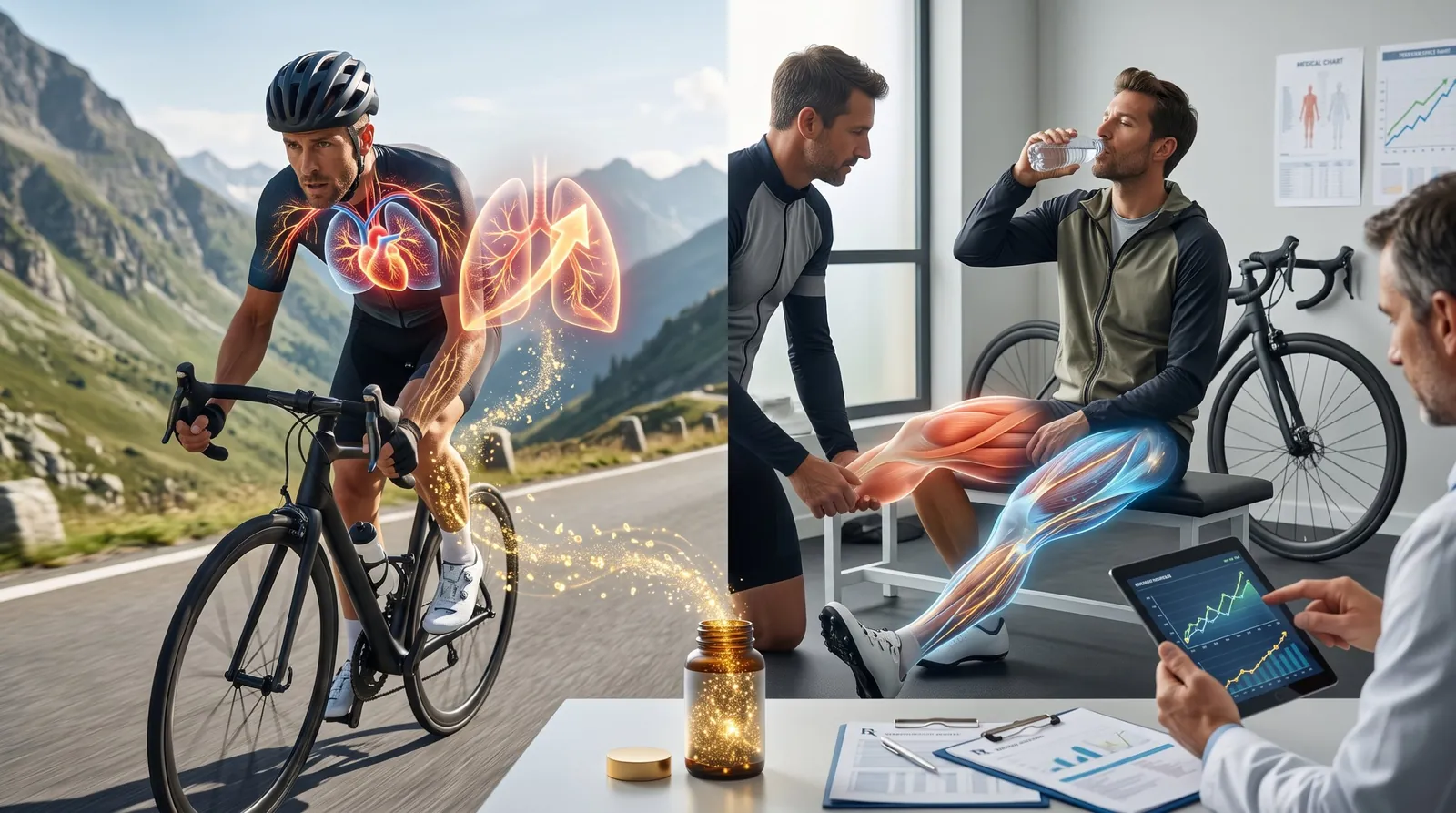
One trial is the exception, and it is the one worth knowing. Forty-eight amateur runners, aged 27 to 50, took 300, 600 or 1,200 mg a day for six weeks while training five or six times a week.
VO2 max did not move. Neither did peak power or O2 pulse. What rose was oxygen uptake and power at the ventilatory thresholds, and it rose with the dose.
Oxygen uptake at the first ventilatory threshold, expressed as a percentage of VO2 max, went up 2.1 points on placebo and 10.3 points on 1,200 mg. The authors read this as better oxygen use by muscle rather than any change in the heart.
Twelve people per arm. Six weeks. One site. Treat it as a promising signal, not a settled finding, and note that no one has replicated it.
A second trial points the same way, more weakly. Eighty healthy adults aged 40 to 65 took placebo, 300, 600 or 900 mg a day for 60 days. Blood NAD+ rose dose-dependently. Six-minute walk distance improved significantly in the 300 mg and 600 mg groups.
A six-minute walk test is a clinical measure of function, not an athletic one. In a group that trains four times a week it is close to a ceiling already. So read that result as evidence NMN can move something, not as evidence it will move something in you.
Forty-eight amateur runners, 6 weeks: oxygen uptake and power at the ventilatory thresholds rose with dose, while VO2 max, peak power and O2 pulse did not change. Eighty middle-aged adults, 60 days: blood NAD+ rose dose-dependently and six-minute walk distance improved at 300 mg and 600 mg.
Source: Liao et al., Journal of the International Society of Sports Nutrition, 2021 (n=48); Yi et al., GeroScience, 2023 (n=80).
This is the part the category tends to skip. EFSA assessed CoQ10 in 2010 against Article 13(1) of Regulation (EC) 1924/2006, covering energy-yielding metabolism, blood pressure, protection from oxidative damage, cognitive function, cholesterol and endurance performance.
None of it was substantiated. No health claim for CoQ10 is authorised on the GB register. So any UK seller telling you their CoQ10 boosts your energy is making a claim regulators have already looked at and refused.
NMN sits further back. Its novel food application, RP-2116, is on the FSA register at the risk assessment phase. We wrote about how that process works in our guide to novel foods in Great Britain.
What follows from this is simple. Judge both on trial data, because the label is not allowed to tell you anything useful.
If your problem is fatigue, the CoQ10 evidence is the better bet. It is a small effect from a large pool, the dose gradient points upward, and single-ingredient products outperformed blends. Buy it on its own or not at all.
If your problem is threshold performance and you are already training hard, NMN has one trial in your direction and a lot of flat results elsewhere. That is a punt, and it should be priced as one. If you take it, take a declared dose from a product that publishes its certificate of analysis, so at least the input to your experiment is known.
If your problem is neither, and you were hoping one of these would make you feel different day to day, the honest answer is that the trials do not support that expectation for either molecule. Sleep, training load and iron status will move that needle further than a capsule. Our guide to NMN dosage sets out what the trials used if you decide to run the experiment anyway.
Pick one. Running both at once means you learn nothing about either.
Pick an outcome you already measure. Threshold power, a fixed running route, session RPE across a training week, or a fatigue score you record the same way each Sunday. Feelings are not data at this effect size.
Give it eight to twelve weeks. The fatigue meta-regression found longer treatment produced larger effects, and the NMN trials ran 14 days to 12 weeks. Anything shorter cannot distinguish a real change from a good fortnight.
Then be willing to stop. A supplement that has not moved your number in three months has told you its answer, and the answer for most people, most of the time, is no.
CoQ10 has more people behind it, an older literature, and a small but consistent effect on fatigue that survives sensitivity analysis. Its ceiling is modest.
NMN raises NAD+ reliably and has yet to convert that into a functional outcome outside one 48-person trial. Its ceiling is unknown, which is different from being high.
Neither is authorised to say any of this on a label in Great Britain. Both are safe at the doses studied. If you want the better-evidenced option today, that is CoQ10, on its own, at the higher end of the tested range.
August 28, 2026
April 4, 2026